 Bug FAQ
Common Grass Skimmer
Paragus haemorrhous · Order: Diptera · Family: Syrphidae
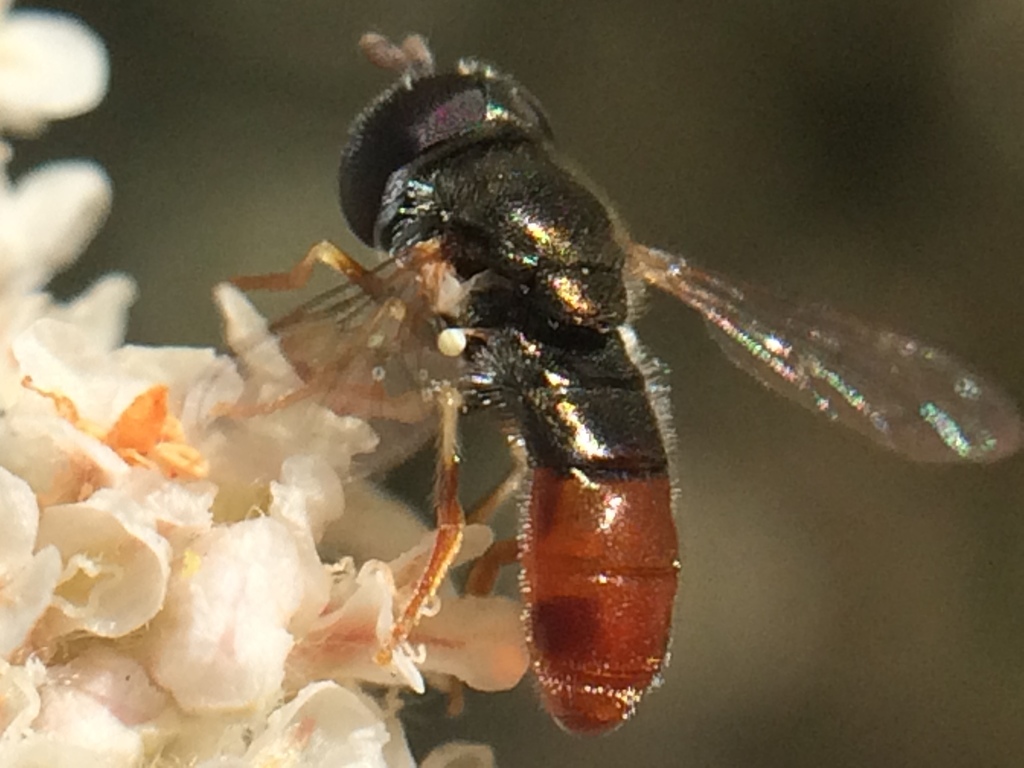
The Common Grass Skimmer is a small hoverfly about 4.3 to 5.9 mm long, with a yellow face marked by a central black stripe and an entirely black scutellum. Adults visit flowers for nectar and pollen, while the larvae prey on aphids on low herbaceous plants, and they are on the wing from May through September in a variety of open grassland and forest edge habitats.
Source: Wikipedia
Where it lives
Found in unimproved grassland, heathland, garrigue, dune grassland, open forest areas up to the Larix/Pinus uncinata zone, and fen meadow edges.
Source: Wikipedia
What it eats
Adults feed on flower nectar and pollen, earning the nickname “flower flies.” Larvae are predators that consume aphids on low herbaceous plants.
Source: Wikipedia
Life cycle
Adults are active and fly from May through September. The larvae are aphid-eating predators.
Source: Wikipedia
When you see it
Flight period spans May to September.
Source: Wikipedia
Where it comes from
Its Palearctic range extends from Fennoscandia south to Iberia, the Mediterranean, Israel, Turkey, Ireland, Central and Southern Europe, and into European Russia; in the Nearctic it occurs from the Yukon down to Costa Rica, with some records in the Afrotropical region.
Source: Wikipedia
Lookalikes
Based on morphological and molecular data, Paragus haemorrhous, P. coadunatus, and P. ascoensis are considered synonyms of Paragus tibialis.
Source: Wikipedia
Where it is found in the US
Recorded in 46 of 51 states and DC. Most records: California, Georgia, Montana, Illinois, Arizona, Virginia, Kansas, New York.
Darker = more records. Counts are museum and citizen-science records, not population size.
Source: GBIF
Status: native in North America; native in Canada. Source: iNaturalist
Months it is reported in the US
Source: GBIF
More photos

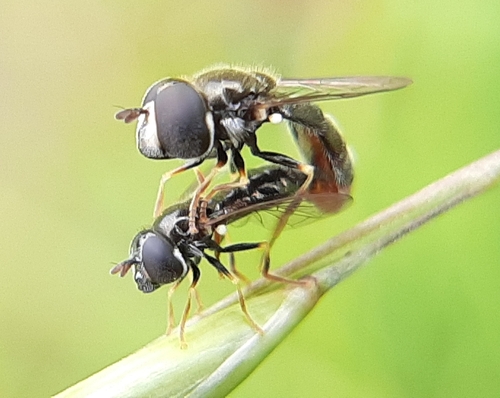
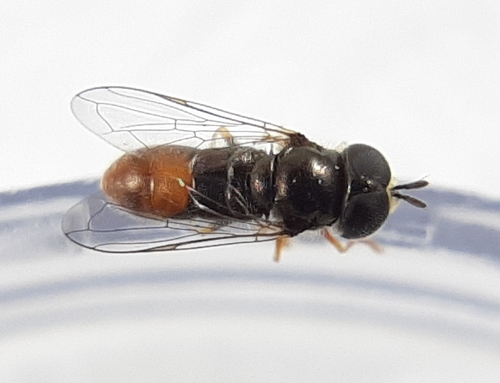
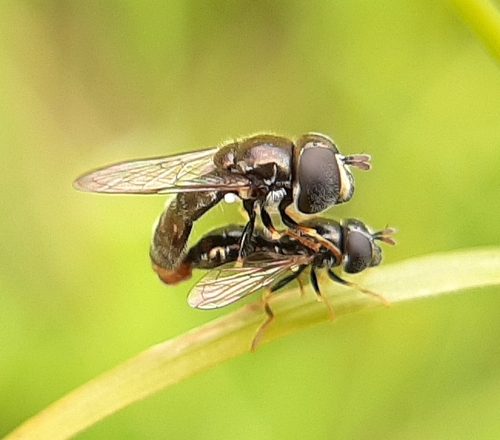
Questions people ask
What do adult Common Grass Skimmers eat?
They visit flowers to drink nectar and collect pollen for protein.
Source: Wikipedia
Where are they likely to be found?
Look for them in open grasslands, heath, dunes, forest edges, and fen meadow paths.
Source: Wikipedia
Same family (Syrphidae)


Sources
- Wikipedia: https://en.wikipedia.org/wiki/Paragus_haemorrhous
Look it up elsewhere: GBIF · iNaturalist · BugGuide · ITIS · Wikipedia
Text written 2026-10-22 from the sources above and checked sentence by sentence against them. Data fetched 2026-10-22.