 Bug FAQ
Common Globetail
Sphaerophoria scripta · Order: Diptera · Family: Syrphidae
Also called: Greenland Globetail, Common Twist-tailed Hoverfly, Long Hover Fly
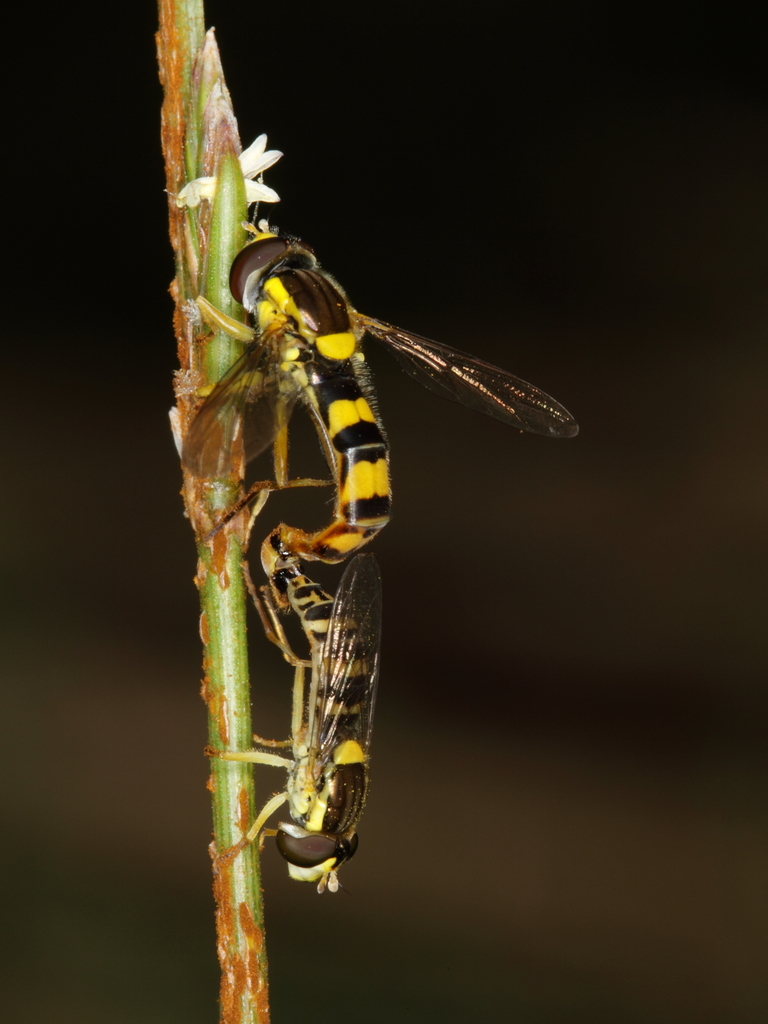
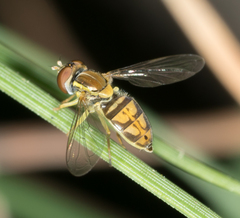
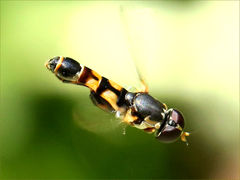
The common globetail is a small hoverfly about 7 to 12 mm long with a narrow, striped body and a long cylindrical abdomen marked by four yellow bands. It lives in gardens, meadows and thickets, feeds on aphids as a larva and on nectar and pollen as an adult, and can be seen from spring to late autumn.
Source: Wikipedia
How to recognize it
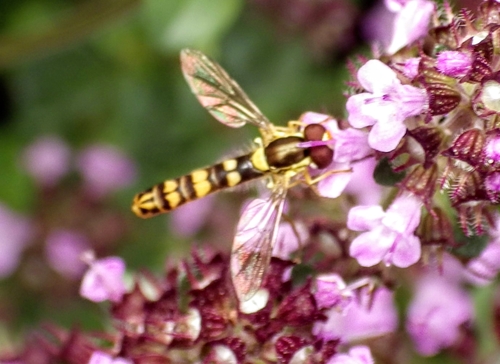
The insect has a long, narrow body with alternating yellow and black bands, and its abdomen shows four wide yellow transverse bands.
Source: Wikipedia
Size
Adults measure 7 to 12 mm in length and have a wingspan of 5 to 7 mm.
Source: Wikipedia
Where it lives
It is found in thickets, gardens and flower-rich meadows.
Source: Wikipedia
What it eats
Larvae eat aphids, while adults sip nectar and collect pollen from various Asteraceae and other flowering plants.
Source: Wikipedia
Life cycle
From egg to adult can take as little as sixteen days, allowing up to nine generations in a year. The species migrates and overwinters in the larval stage.
Source: Wikipedia
When you see it
Adults are active from April through November.
Source: Wikipedia
Where it comes from
The species occurs worldwide, including most of Europe, the eastern Palearctic, the Near East, North Africa, the Nearctic and the Indomalayan regions.
Source: Wikipedia
Where it is found in the US
Recorded in 5 of 51 states and DC. Most records: Pennsylvania, New York, Wisconsin, New Jersey, Utah.
Darker = more records. Counts are museum and citizen-science records, not population size.
Source: GBIF
Status: native in North America; native in Canada. Source: iNaturalist
Months it is reported in the US
Source: GBIF
More photos
Questions people ask
Are they a garden pest?
No, the larvae actually help by eating aphids, and adults pollinate flowers.
Source: Wikipedia
Same family (Syrphidae)


Sources
- Wikipedia: https://en.wikipedia.org/wiki/Sphaerophoria_scripta
Look it up elsewhere: GBIF · iNaturalist · BugGuide · ITIS · Wikipedia
Text written 2026-10-22 from the sources above and checked sentence by sentence against them. Data fetched 2026-10-22.