 Bug FAQ
Common Giant Turtle Ant
Cephalotes atratus · Order: Hymenoptera · Family: Formicidae

Workers are 8 to 14 mm long, females reach about 20 mm and males up to 14 mm. They live in trees, building nests in hollows of large live or dead trunks in forests, parks and urban areas. They are omnivorous and take a lot of treehopper secretions as food.
Source: Wikipedia
How to recognize it
It is a large, mainly black ant.
Source: Wikipedia
Size
Workers measure 8 to 14 mm, females about 20 mm, and males up to 14 mm.
Source: Wikipedia
Where it lives
Nests are made in hollows of large live or dead trees.
Source: Wikipedia
What it eats
It is omnivorous, eating whatever it can find. A major part of its diet consists of secretions produced by treehoppers.
Source: Wikipedia
Life cycle
The nematode develops inside the ant and moves to the ant’s gaster as it matures.
Source: Wikipedia
Lookalikes
It belongs to the genus Cephalotes, which is known for its oddly shaped head. These ants can glide by steering their fall if they lose footing.
Source: Wikipedia
More photos

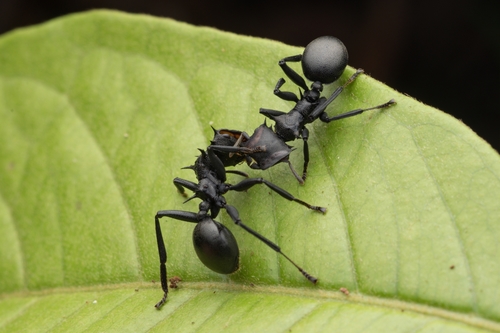
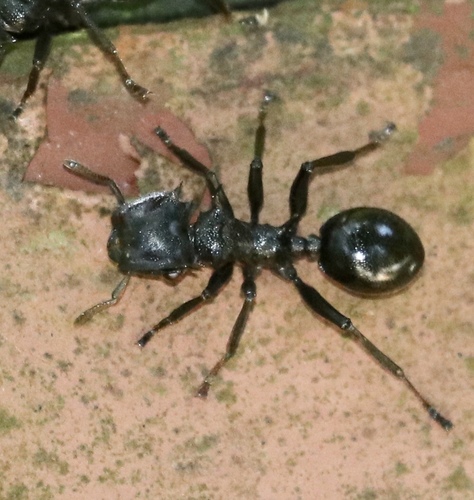
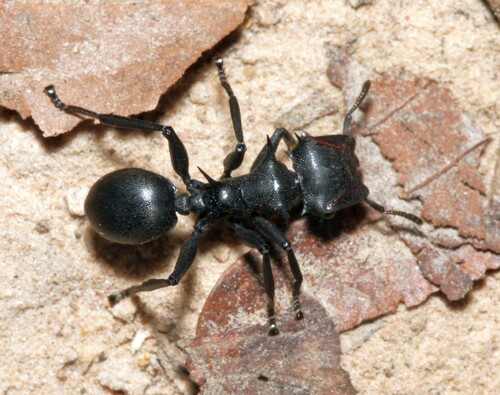
Questions people ask
How big are Common Giant Turtle Ants?
Workers are 8 to 14 mm long, females about 20 mm, and males up to 14 mm.
Source: Wikipedia
Where do they live?
They live in trees, nesting in hollows of large live or dead trunks in forests, parks and urban areas.
Source: Wikipedia
What do they eat?
They are omnivorous and feed heavily on secretions from treehoppers.
Source: Wikipedia
What region are they native to?
They occur in lowland tropical rainforests from Panama and Venezuela down to northern Argentina.
Source: Wikipedia
Same family (Formicidae)
 Eastern Black Carpenter AntCamponotus pennsylvanicusCan damage your home
 Red Imported Fire AntSolenopsis invictaCan sting
 American Winter AntPrenolepis imparis
 Argentine AntLinepithema humileNuisance, not dangerous
 Immigrant Pavement AntTetramorium immigransCan sting
 Odorous House AntTapinoma sessileCan damage your home
Sources
- Wikipedia: https://en.wikipedia.org/wiki/Cephalotes_atratus
Look it up elsewhere: GBIF · iNaturalist · BugGuide · ITIS · Wikipedia
Text written 2026-10-23 from the sources above and checked sentence by sentence against them. Data fetched 2026-10-22.