 Bug FAQ
Common Emerald
Hemithea aestivaria · Order: Lepidoptera · Family: Geometridae
Source: Wikipedia
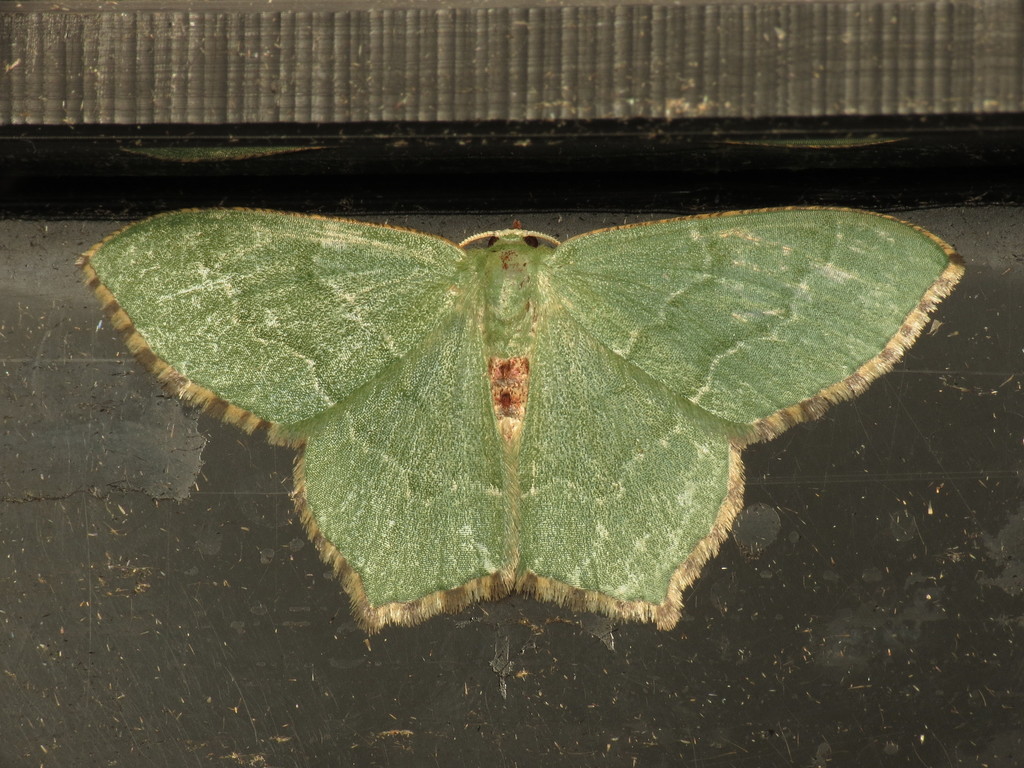
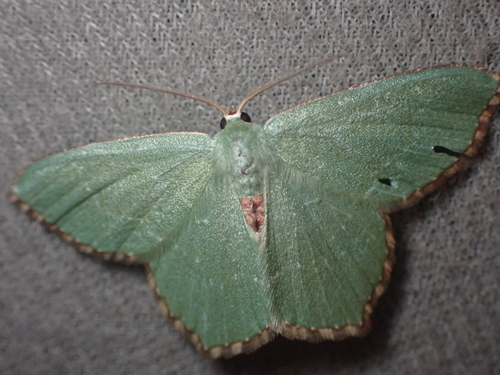
The common emerald moth has a wingspan of about 30 to 35 mm and soft grey-green wings with chequered grey-white edges and narrow white bands. It flies at dusk in June and July, is attracted to light, and overwinters as a larva that later feeds on trees and shrubs.
Source: Wikipedia
How to recognize it
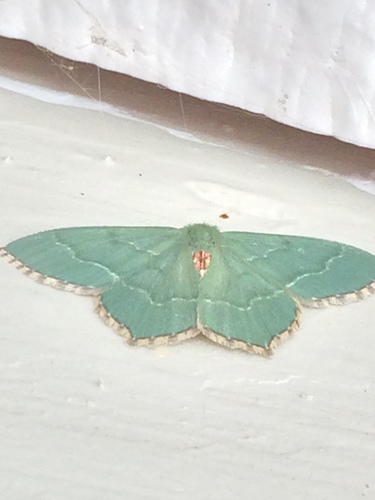
All wings are a soft grey-green with chequered grey and white fringes and have narrow white bands, two on each forewing and one on each hindwing. The hindwings have a sharply angled outer edge that gives the moth a distinctive shape.
Source: Wikipedia
Size
The wingspan ranges from 30 to 35 mm.
Source: Wikipedia
Where it lives
It was accidentally introduced to southern British Columbia in 1973.
Source: Wikipedia
What it eats
Young larvae eat a wide range of plants, while later instars feed on the leaves of trees and shrubs.
Source: Wikipedia
Life cycle
The species overwinters in the larval stage.
Source: Wikipedia
When you see it
Adults are active at dusk and night during June and July and are attracted to light.
Source: Wikipedia
Where it comes from
The species occurs across the Nearctic, Palearctic and Near East regions.
Source: Wikipedia
Lookalikes
Historical synonyms include Phalaena aestivaria Hübner, 1789 and Phalaena strigata Müller.
Source: Wikipedia
Where it is found in the US
Recorded in 3 of 51 states and DC. Most records: Washington, New York, Oregon.
Darker = more records. Counts are museum and citizen-science records, not population size.
Source: GBIF
Status: introduced in Canada; introduced in United States. Source: iNaturalist
Months it is reported in the US
Source: GBIF
More photos
Same family (Geometridae)
 Willow BeautyPeribatodes rhomboidaria
 Pale BeautyCampaea perlataDamages trees, gardens or crops
 Large Lace-border MothScopula limboundataDamages trees, gardens or crops
 Riband WaveIdaea aversata
 Yellow Shell MothCamptogramma bilineata
 Large Maple Spanworm MothProchoerodes lineolaDamages trees, gardens or crops
Sources
- Wikipedia: https://en.wikipedia.org/wiki/Common_emerald
Look it up elsewhere: GBIF · iNaturalist · BugGuide · ITIS · Wikipedia
Text written 2026-10-22 from the sources above and checked sentence by sentence against them. Data fetched 2026-10-22.