 Bug FAQ
Common Dotted Wainscot
Ichneutica semivittata · Order: Lepidoptera · Family: Noctuidae
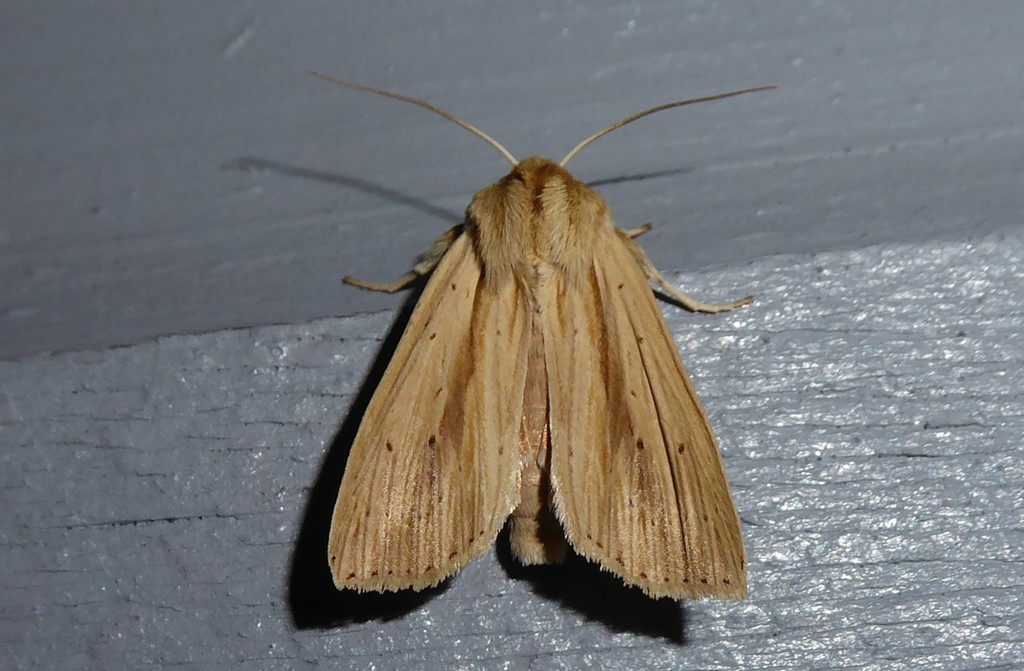
The Common Dotted Wainscot is a moth native to New Zealand, found from the Three Kings Islands down to Stewart Island. Adults have a wingspan of about 30 to 42 mm and show a distinctive reddish-ochreous streak on the forewing. They fly from August to April, are attracted to light, and their larvae feed on native grasses and rushes such as Poa, Festuca and Juncus species.
Source: Wikipedia
How to recognize it
A reddish ochreous streak on the forewing distinguishes this species.
Source: Wikipedia
Size
Male wingspan ranges from 30 to 42 mm; females from 31 to 40 mm.
Source: Wikipedia
Where it lives
It lives in many habitats, from open grasslands to forest clearings, from sea level up to the alpine zone.
Source: Wikipedia
What it eats
The caterpillars grow to about 1¼ inches long while feeding on these grasses.
Source: Wikipedia
When you see it
They are active from late winter through autumn (August to April) and are commonly caught with mercury-vapour light traps.
Source: Wikipedia
Where it comes from
The species is endemic to New Zealand. Its range extends from the Three Kings Islands south to Stewart Island.
Source: Wikipedia
More photos
Questions people ask
When are Common Dotted Wainscot moths active?
Adults fly from August through April and are attracted to lights.
Source: Wikipedia
What do the larvae eat?
The caterpillars feed on native rushes, sedges and tussock grasses such as Poa and Festuca species.
Source: Wikipedia
How can I tell this moth apart from similar species?
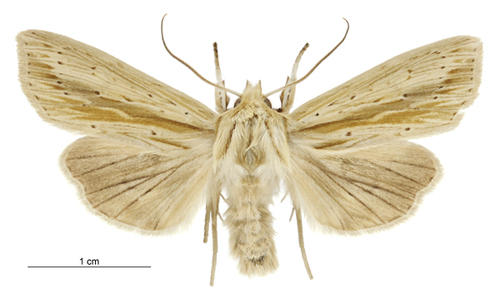
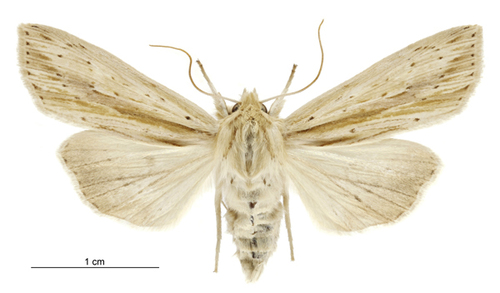
Look for a reddish-ochreous streak on the forewing and eight or nine spots behind the middle of the wing; the similar I. sulcana is larger, darker and has only one to three spots.
Source: Wikipedia
Same family (Noctuidae)
 Ipsilon Dart MothAgrotis ipsilonDamages trees, gardens or crops
 Fall Armyworm MothSpodoptera frugiperdaDamages trees, gardens or crops
 Army Cutworm MothEuxoa auxiliarisDamages trees, gardens or crops
 Large Yellow UnderwingNoctua pronubaDamages trees, gardens or crops
 Silver ΥAutographa gamma
 American DaggerAcronicta americanaCan irritate skin
Sources
- Wikipedia: https://en.wikipedia.org/wiki/Ichneutica_semivittata
Look it up elsewhere: GBIF · iNaturalist · BugGuide · Wikipedia
Text written 2026-10-23 from the sources above and checked sentence by sentence against them. Data fetched 2026-10-23.