 Bug FAQ
Colorful Cherry Millipede
Apheloria polychroma · Order: Polydesmida · Family: Xystodesmidae
Source: Wikipedia
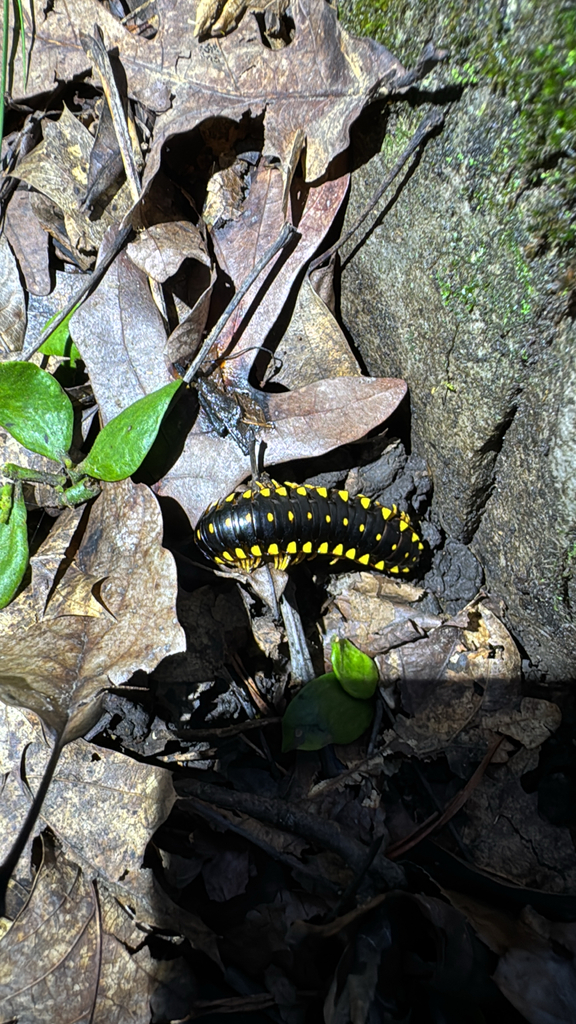
It lives in moist deciduous forests of Kentucky, Virginia, Tennessee and Georgia, often under decaying leaves, and when disturbed it releases a cyanide-smelling spray that can irritate skin.
Source: Wikipedia
How to recognize it
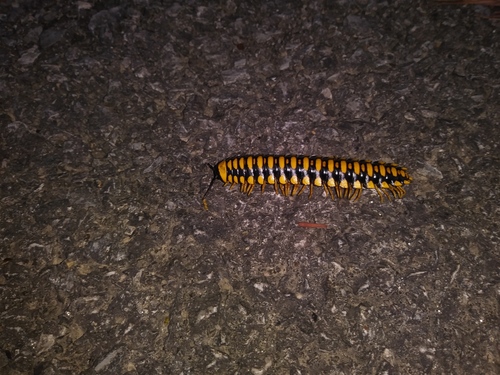
This four-spot pattern occurs east of Cumberland Mountain, from Big Stone Gap, Virginia to Norris, Tennessee.
Source: Wikipedia
Size
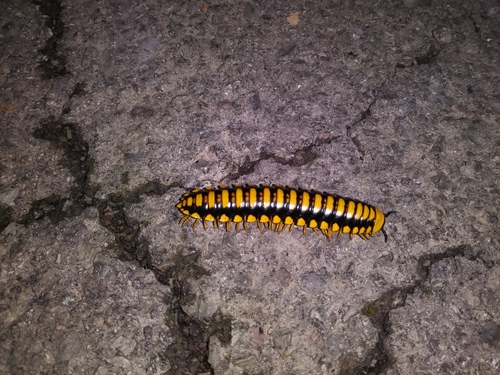
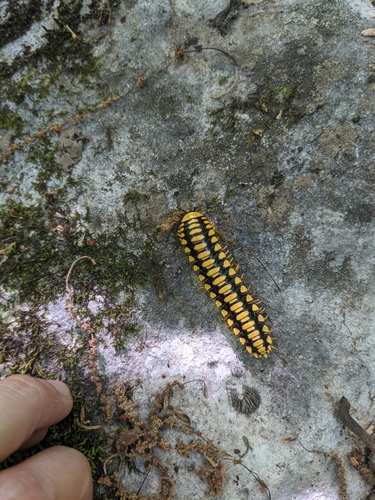
The species can reach about two inches long.
Source: Wikipedia
Can it bite, sting or make you sick?
Handling the millipede causes it to release a large amount of these secretions.
Source: Wikipedia
Where it lives
It is usually found in moist deciduous forests and occasionally in drier glades such as mixed forest with eastern red cedar.
Source: Wikipedia
What it eats
Its feces provide food for microbes, fungi and plants.
Source: Wikipedia
Life cycle
The male gonopods have a uniformly narrow, circular distal part and a scythe-shaped proximal projection.
Source: Wikipedia
When you see it
When handled, it emits a large quantity of defensive secretions.
Source: Wikipedia
Where it comes from
It occurs in Kentucky, Virginia, Tennessee and Georgia.
Source: Wikipedia
Lookalikes
It can be confused with its close relative Apheloria montana in eastern Tennessee. It is distinguished from other Apheloria species by the shape of its gonopods.
Source: Wikipedia
Where it is found in the US
Recorded in 4 of 51 states and DC. Most records: Virginia, Tennessee, Kentucky, Georgia.
Darker = more records. Counts are museum and citizen-science records, not population size.
Source: GBIF
Months it is reported in the US
Source: GBIF
More photos
Questions people ask
How big does it get?
Adults are 38 to 58 mm long, about two inches, with females larger than males.
Source: Wikipedia
Where is it found?
It lives in moist forests of Kentucky, Virginia, Tennessee and Georgia, often under leaf litter.
Source: Wikipedia
Is it dangerous to handle?
When disturbed it sprays hydrogen cyanide-containing secretions that can irritate skin.
Source: Wikipedia
Same family (Xystodesmidae)



Sources
- Wikipedia: https://en.wikipedia.org/wiki/Apheloria_polychroma
Look it up elsewhere: GBIF · iNaturalist · BugGuide · Wikipedia
Text written 2026-10-26 from the sources above and checked sentence by sentence against them. Data fetched 2026-10-26.