 Bug FAQ
Clay Triple-Lines
Cyclophora linearia · Order: Lepidoptera · Family: Geometridae
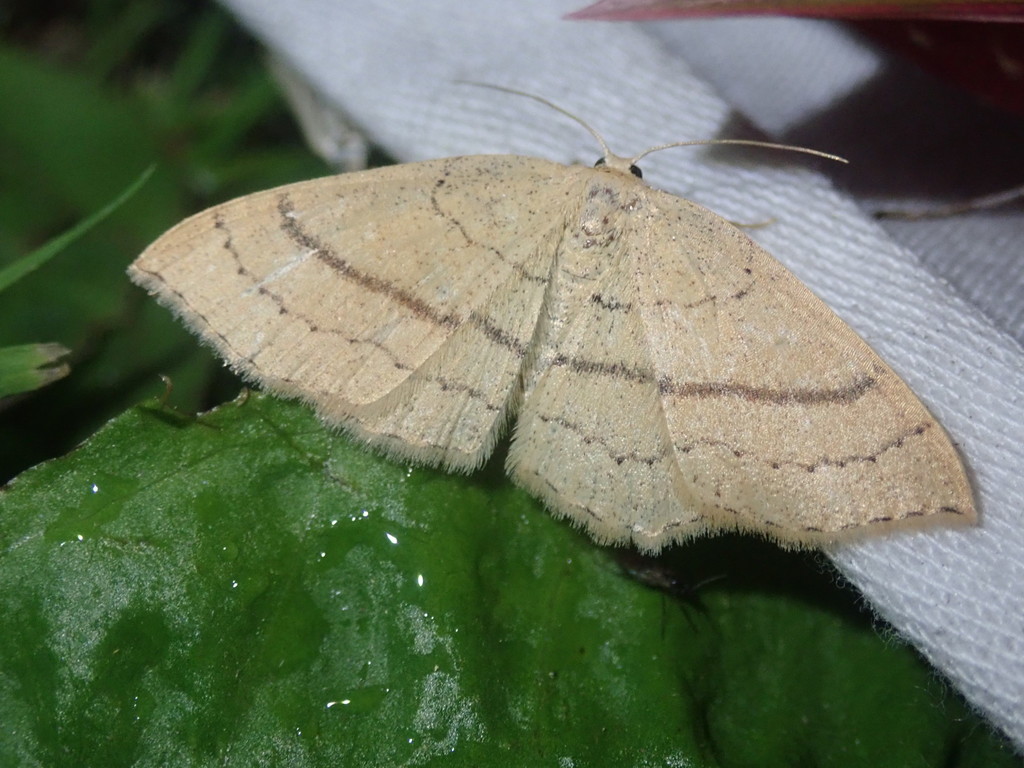
The clay triple-lines is a small moth with a wingspan of about 26 to 33 mm. It lives in Europe, especially the southern half of Britain, and the caterpillars feed on beech leaves.
Source: Wikipedia
How to recognize it
First-generation adults have pale brown to orange wings, while the second generation is rose-red. Each forewing bears three black-to-reddish crosslines, the middle one being the broadest. In the second generation the crosslines may appear vague.
Source: Wikipedia
Size
The wingspan ranges from 26 to 33 mm.
Source: Wikipedia
Where it lives
It belongs to the Geometridae family of moths.
Source: Wikipedia
What it eats
The larvae feed on beech trees.
Source: Wikipedia
Life cycle
Adults are on the wing from May to July, depending on location.
Source: Wikipedia
When you see it
Flight period is May through July, varying with region.
Source: Wikipedia
Where it comes from
First described in 1799, it occurs across Europe and mainly the southern part of Britain.
Source: Wikipedia
Lookalikes
It can be confused with several close relatives: Blair's mocha (Cyclophora puppillaria), Jersey mocha (C. ruficiliaria), Maiden’s blush (C. punctaria), and false mocha (C. porata).
Source: Wikipedia
More photos

Questions people ask
When can I see adult clay triple-lines?
Adults fly from May to July, though the exact timing depends on where you are.
Source: Wikipedia
Same family (Geometridae)
 Willow BeautyPeribatodes rhomboidaria
 Pale BeautyCampaea perlataDamages trees, gardens or crops
 Large Lace-border MothScopula limboundataDamages trees, gardens or crops
 Riband WaveIdaea aversata
 Yellow Shell MothCamptogramma bilineata
 Large Maple Spanworm MothProchoerodes lineolaDamages trees, gardens or crops
Sources
- Wikipedia: https://en.wikipedia.org/wiki/Cyclophora_linearia
Look it up elsewhere: GBIF · iNaturalist · BugGuide · Wikipedia
Text written 2026-10-22 from the sources above and checked sentence by sentence against them. Data fetched 2026-10-22.