 Bug FAQ
North American Elm Sawfly
Cimbex americana · Order: Hymenoptera · Family: Cimbicidae
Also called: elm sawfly

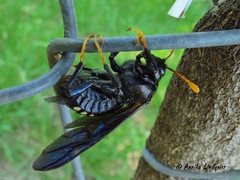
Adults are about 3 cm long and the larvae can grow up to 5 cm. It is the elm sawfly, a member of the family Cimbicidae. Like other sawflies, it does not have a sting.
Source: Wikipedia
How to recognize it
This sawfly lacks a sting, as do other sawflies.
Source: Wikipedia
Size
Adults reach about 3 cm and larvae can be as long as 5 cm.
Source: Wikipedia
Does it bite or sting?
It does not possess a sting.
Source: Wikipedia
Life cycle
The wasp Opheltes glaucopterus parasitizes the prepupal stage of this sawfly.
Source: Wikipedia
Where it comes from
Cimbex americana is the elm sawfly in the family Cimbicidae.
Source: Wikipedia
Where it is found in the US
Recorded in 50 of 51 states and DC. Most records: Texas, Alaska, Vermont, Illinois, New York, Minnesota, Maine, Ohio.
Darker = more records. Counts are museum and citizen-science records, not population size.
Source: GBIF
Months it is reported in the US
Source: GBIF
Questions people ask
Same family (Cimbicidae)


Sources
- Wikipedia: https://en.wikipedia.org/wiki/Cimbex_americanus
Look it up elsewhere: GBIF · BugGuide · ITIS · Wikipedia
Text written 2026-10-23 from the sources above and checked sentence by sentence against them. Data fetched 2026-10-23.