 Bug FAQ
Birch Sawfly
Cimbex femoratus · Order: Hymenoptera · Family: Cimbicidae
Also called: Birch Clubhorn

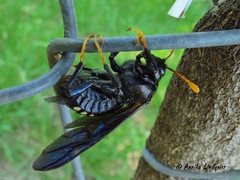
The birch sawfly is a medium-sized insect that lives where birch trees grow. Adults are active from May through August and can be recognized by their large head, strong mandibles, smoky brown wings with brown edges, a shiny black thorax, and a black-yellow-orange patterned abdomen and legs. It is native to Europe and Siberia and also occurs in Canada.
Source: Wikipedia
How to recognize it
The head is large with strong mandibles. Wings are smoky brown with brown margins. The thorax is shiny black. The last leg segments are yellowish.
Source: Wikipedia
Size
Adults measure 17 to 23 mm in length.
Source: Wikipedia
Where it lives
They prefer areas where birch trees are present.
Source: Wikipedia
Life cycle
Adults fly from May to August.
Source: Wikipedia
When you see it
Adults are active during the months of May through August.
Source: Wikipedia
Where it comes from
They are widespread throughout Europe and Siberia. They are also found in Canada.
Source: Wikipedia
Lookalikes
Varieties include var. griffinii, var. pallens, var. silvarum, and var. varians.
Source: Wikipedia
More photos


Questions people ask
What do birch sawflies look like?
They have a large head with strong mandibles, smoky brown wings with brown edges, a shiny black thorax, and a patterned abdomen and legs.
Source: Wikipedia
Where do birch sawflies live?
They live in areas where birch trees grow and are found across Europe, Siberia, and Canada.
Source: Wikipedia
Same family (Cimbicidae)
Sources
- Wikipedia: https://en.wikipedia.org/wiki/Cimbex_femoratus
Look it up elsewhere: GBIF · iNaturalist · BugGuide · Wikipedia
Text written 2026-10-23 from the sources above and checked sentence by sentence against them. Data fetched 2026-10-22.