 Bug FAQ
Centromerus sylvaticus
Centromerus sylvaticus · Order: Araneae · Family: Linyphiidae
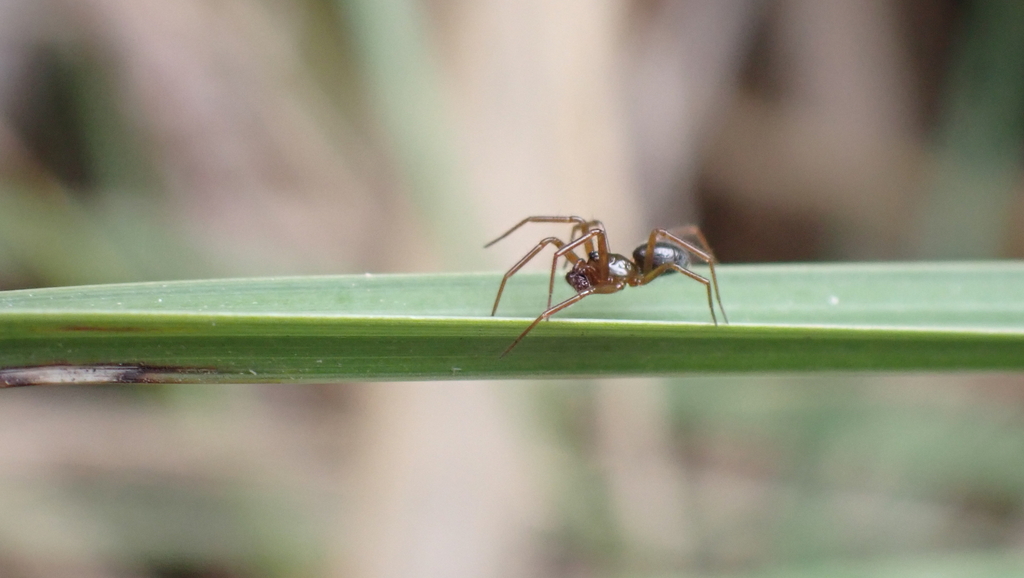
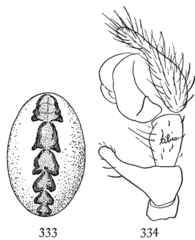
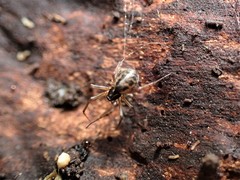
Adults measure between about 2.2 and 4 mm in length. The cephalothorax is yellow-brown with a dark edge around the head, while the abdomen is gray or black with bright crosswise stripes. It occurs across North America and Europe, extending through Turkey, Russia, China, Korea and Japan.
Source: Wikipedia
How to recognize it
The prosoma is yellow-brown with a dark margin near the head. The opisthosoma is gray or black and shows bright transverse lines.
Source: Wikipedia
Size
Its body length ranges from 2.2 mm to 4 mm.
Source: Wikipedia
Where it comes from
Its range also includes Turkey, Russia (from European parts to the Far East), China, Korea and Japan.
Source: Wikipedia
Where it is found in the US
Recorded in 11 of 51 states and DC. Most records: Alaska, Maine, Wisconsin, Illinois, Ohio, North Dakota, Indiana, Massachusetts.
Darker = more records. Counts are museum and citizen-science records, not population size.
Source: GBIF
Status: native in North America; native in Canada. Source: iNaturalist
Months it is reported in the US
Source: GBIF
More photos


Same family (Linyphiidae)

Sources
- Wikipedia: https://en.wikipedia.org/wiki/Centromerus_sylvaticus
Look it up elsewhere: GBIF · iNaturalist · BugGuide · ITIS · Wikipedia
Text written 2026-10-28 from the sources above and checked sentence by sentence against them. Data fetched 2026-10-28.