 Bug FAQ
Black-tailed Red Sheetweaver
Florinda coccinea · Order: Araneae · Family: Linyphiidae

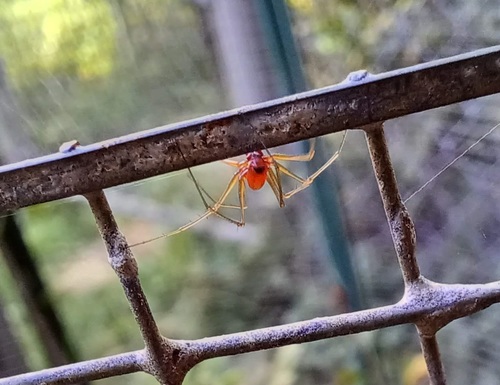
Adults are tiny, only about 3 to 4 mm long and are bright red with a black tip on the abdomen. They live in the southeastern United States, especially in grasslands, lawns and farm fields, and have also been recorded in Mexico and the West Indies. The spider spins a horizontal sheet of non-sticky silk with a tangle of stopping threads above to trap flying insects.
Source: Wikipedia
How to recognize it
The spider is bright red and has a black tubercle at the end of its abdomen.
Source: Wikipedia
Size
Adults measure about 3 to 4 mm (0.12 to 0.16 in) in length.
Source: Wikipedia
Lookalikes
It is the only species in its genus, so there are no similar species to confuse it with.
Source: Wikipedia
Where it is found in the US
Recorded in 32 of 51 states and DC. Most records: Florida, Texas, Virginia, North Carolina, Tennessee, Maryland, Louisiana, Ohio.
Darker = more records. Counts are museum and citizen-science records, not population size.
Source: GBIF
Status: native in North America; native in United States. Source: iNaturalist
Months it is reported in the US
Source: GBIF
More photos


Questions people ask
What does the black-tailed red sheetweaver look like?
It is bright red with a black tip on the abdomen and only about 3 to 4 mm long.
Source: Wikipedia
Where is this spider found?
It lives in the southeastern United States in grasslands, lawns and fields, and has also been recorded in Mexico and the West Indies.
Source: Wikipedia
How does the spider catch its prey?
It spins a horizontal sheet of non-sticky silk with a tangle of stopping threads above that knock flying insects onto the sheet where they are captured.
Source: Wikipedia
Are there any other spiders that look similar?
No, it is the only species in its genus, so there are no look-alike species.
Source: Wikipedia
Same family (Linyphiidae)
Sources
- Wikipedia: https://en.wikipedia.org/wiki/Blacktailed_red_sheetweaver
Look it up elsewhere: GBIF · iNaturalist · BugGuide · ITIS · Wikipedia
Text written 2026-10-23 from the sources above and checked sentence by sentence against them. Data fetched 2026-10-23.