 Bug FAQ
Carolinian Elegant
Meromacrus acutus · Order: Diptera · Family: Syrphidae
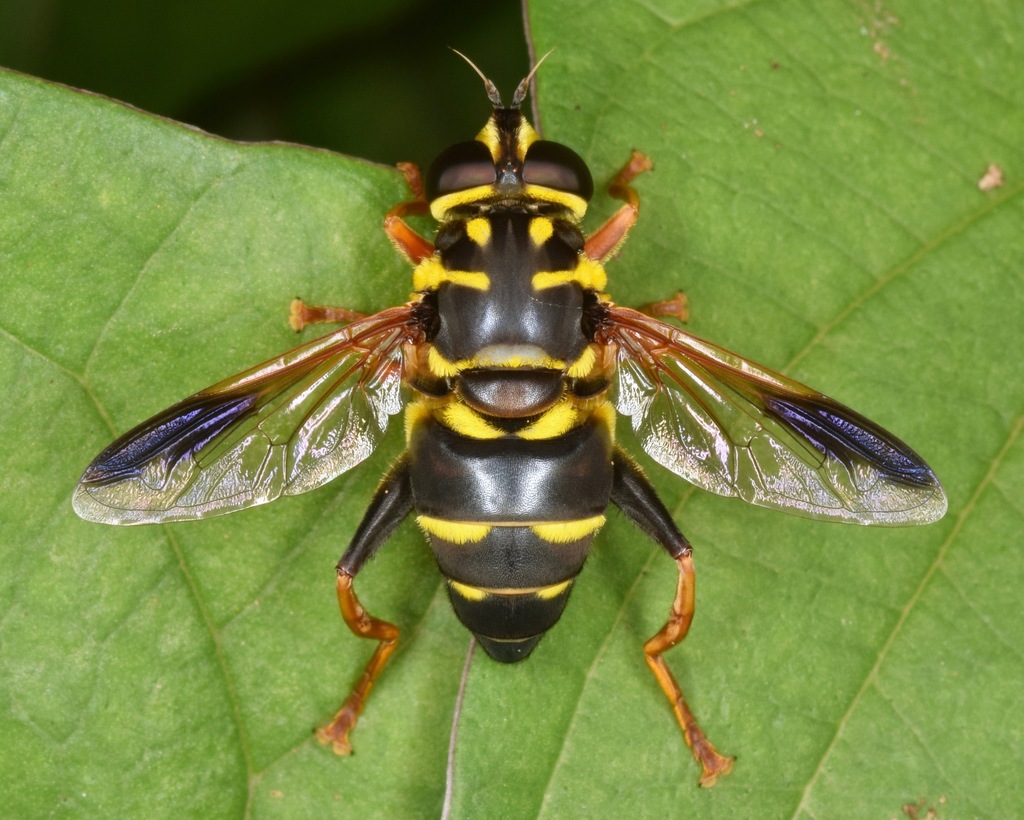
The Carolinian Elegant hoverfly is 13 to 18 mm long and shows a black body with bright yellow markings that look like a wasp. Adults visit flowers for nectar and pollen, while the larvae live in water-filled tree holes and filter feed with a rat-tailed siphon.
Source: Wikipedia
How to recognize it
It has a striking black and yellow pattern that mimics wasps. The thorax is shiny black with vivid golden yellow markings.
Source: Wikipedia
Size
Length ranges from 13 to 18 mm (about half to three-quarters of an inch).
Source: Wikipedia
Where it lives
Adults are commonly found on flowers where they feed on nectar and pollen. Larvae develop in water-filled rot holes of trees, filtering organic matter.
Source: Wikipedia
What it eats
Adults eat flower nectar for energy and pollen for protein. Larvae are aquatic filter-feeders using a rat-tailed siphon.
Source: Wikipedia
Life cycle
Hoverflies can hover almost motionless in flight. The larvae are rat-tailed filter-feeders living in tree-hole water.
Source: Wikipedia
Where it comes from
It occurs in the eastern United States and parts of South America.
Source: Wikipedia
Lookalikes
Its black-and-yellow coloration makes it resemble a wasp.
Source: Wikipedia
Where it is found in the US
Recorded in 26 of 51 states and DC. Most records: Texas, Florida, North Carolina, Virginia, Maryland, Georgia, Louisiana, Tennessee.
Darker = more records. Counts are museum and citizen-science records, not population size.
Source: GBIF
Months it is reported in the US
Source: GBIF
More photos


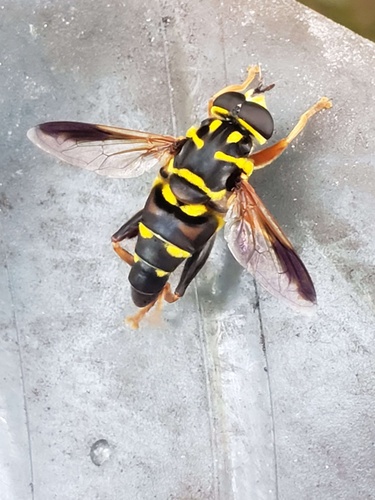
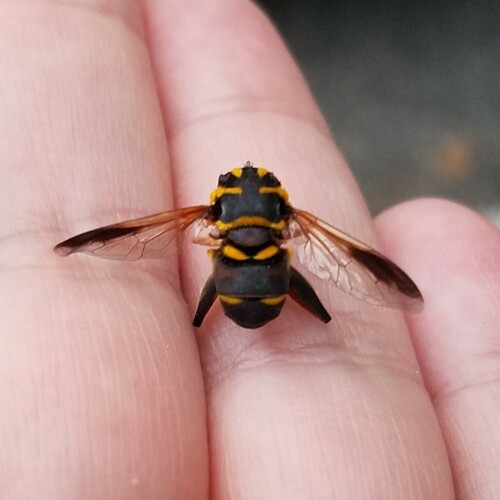
Same family (Syrphidae)






Sources
- Wikipedia: https://en.wikipedia.org/wiki/Meromacrus_acutus
Look it up elsewhere: GBIF · iNaturalist · BugGuide · ITIS · Wikipedia
Text written 2026-10-23 from the sources above and checked sentence by sentence against them. Data fetched 2026-10-22.