 Bug FAQ
Cabbage tree moth
Epiphryne verriculata · Order: Lepidoptera · Family: Geometridae
Also called: Cabbage Tree Looper
Source: Wikipedia
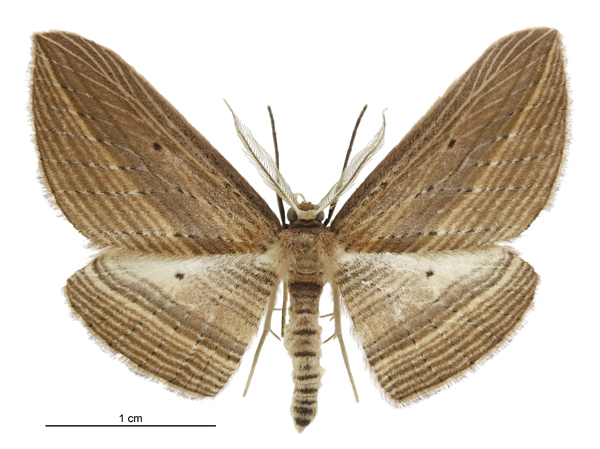
Adults have a wingspan of about 3.8 cm and show light brown wings with parallel brown lines. They live in wetlands, native forests and also in urban parks where cabbage trees are planted, and can be seen from October to May.
Source: Wikipedia
How to recognize it
The wings are generally light brown with parallel brownish lines running across them.
Source: Wikipedia
Size
The adult’s wingspan measures roughly 3.8 cm.
Source: Wikipedia
Where it lives
It prefers wetland and native forest habitats but also occurs in urban parks and gardens where cabbage trees grow.
Source: Wikipedia
What it eats
Larvae feed exclusively on the leaves of several cabbage-tree species (Cordyline).
Source: Wikipedia
Life cycle
The species takes several months to develop from egg to adult. Larvae pass through five instars, shedding their skin between each growth stage.
Source: Wikipedia
When you see it
Adults are on the wing from spring through late summer, roughly October to May.
Source: Wikipedia
Where it comes from
This moth is found only in New Zealand, where it is widespread.
Source: Wikipedia
More photos
Questions people ask
When can I expect to see adult cabbage tree moths?
Adults are active from October through May.
Source: Wikipedia
Where does this moth live?
It lives in wetlands, native forests, and urban parks or gardens with cabbage trees.
Source: Wikipedia
Same family (Geometridae)
 Willow BeautyPeribatodes rhomboidaria
 Pale BeautyCampaea perlataDamages trees, gardens or crops
 Large Lace-border MothScopula limboundataDamages trees, gardens or crops
 Riband WaveIdaea aversata
 Yellow Shell MothCamptogramma bilineata
 Large Maple Spanworm MothProchoerodes lineolaDamages trees, gardens or crops
Sources
- Wikipedia: https://en.wikipedia.org/wiki/Epiphryne_verriculata
Look it up elsewhere: GBIF · iNaturalist · BugGuide · Wikipedia
Text written 2026-10-23 from the sources above and checked sentence by sentence against them. Data fetched 2026-10-22.