 Bug FAQ
Burchell's Army Ant
Eciton burchellii · Order: Hymenoptera · Family: Formicidae
Also called: Army ant
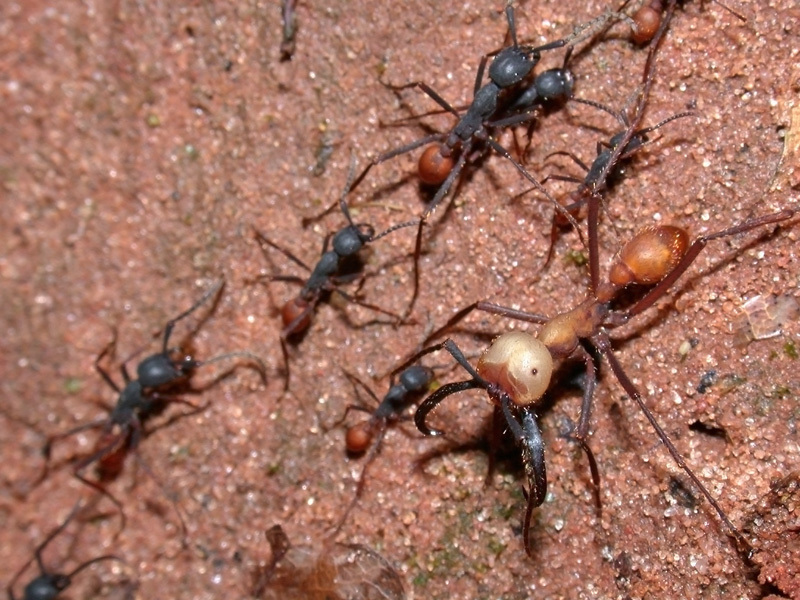
Eciton burchellii workers range from 3 mm to 12 mm and have long legs, a spider-like body, and a well-developed sting. They live in damp, shaded tropical jungles from Mexico to Paraguay and move their bivouac at night during nomadic phases. Colonies can contain up to 600 000 adults, send out raids of up to 200 000 ants that can stretch 200 m, and support hundreds of other species that follow their raids.
Source: Wikipedia
How to recognize it
Workers have single-faceted eyes, a double-segmented waist, a strong sting, and tarsal hooks that let them link together into bridges and bivouacs.
Source: Wikipedia
Where it lives
They inhabit tropical jungles of Central and South America, preferring damp, shaded areas and avoiding direct sun and high elevations.
Source: Wikipedia
What it eats
During raids, up to 200 000 ants follow pheromone trails for distances of about 200 m to hunt prey. Over 500 other species, including antbirds, mites, and beetles, associate with their colonies, many relying on the ants for food or habitat.
Source: Wikipedia
Life cycle
A colony may hold 100 000 to 600 000 adults, consisting of a single queen, brood, and many workers. Colonies alternate between stationary and nomadic phases, moving nightly as the brood develops.
Source: Wikipedia
When you see it
In each nomadic phase the colony finds a new nest, taking six to eight hours to relocate its bivouac, usually at night.
Source: Wikipedia
Where it comes from
Their native range extends from Mexico through Central America to Paraguay.
Source: Wikipedia
Lookalikes
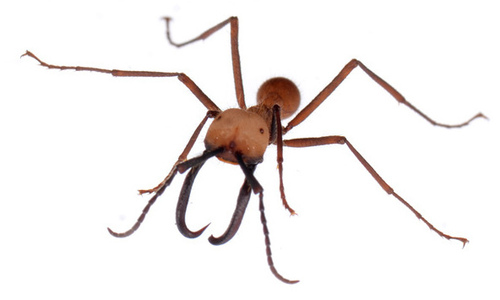
Eciton burchellii belongs to the New World army ant genus Eciton. Its soldier caste has long, sickle-shaped mandibles typical of Eciton species.
Source: Wikipedia
More photos

Same family (Formicidae)
 Eastern Black Carpenter AntCamponotus pennsylvanicusCan damage your home
 Red Imported Fire AntSolenopsis invictaCan sting
 American Winter AntPrenolepis imparis
 Argentine AntLinepithema humileNuisance, not dangerous
 Immigrant Pavement AntTetramorium immigransCan sting
 Odorous House AntTapinoma sessileCan damage your home
Sources
- Wikipedia: https://en.wikipedia.org/wiki/Eciton_burchellii
Look it up elsewhere: GBIF · iNaturalist · BugGuide · ITIS · Wikipedia
Text written 2026-10-23 from the sources above and checked sentence by sentence against them. Data fetched 2026-10-22.