 Bug FAQ
Bumble Bee Hover Fly
Volucella bombylans · Order: Diptera · Family: Syrphidae
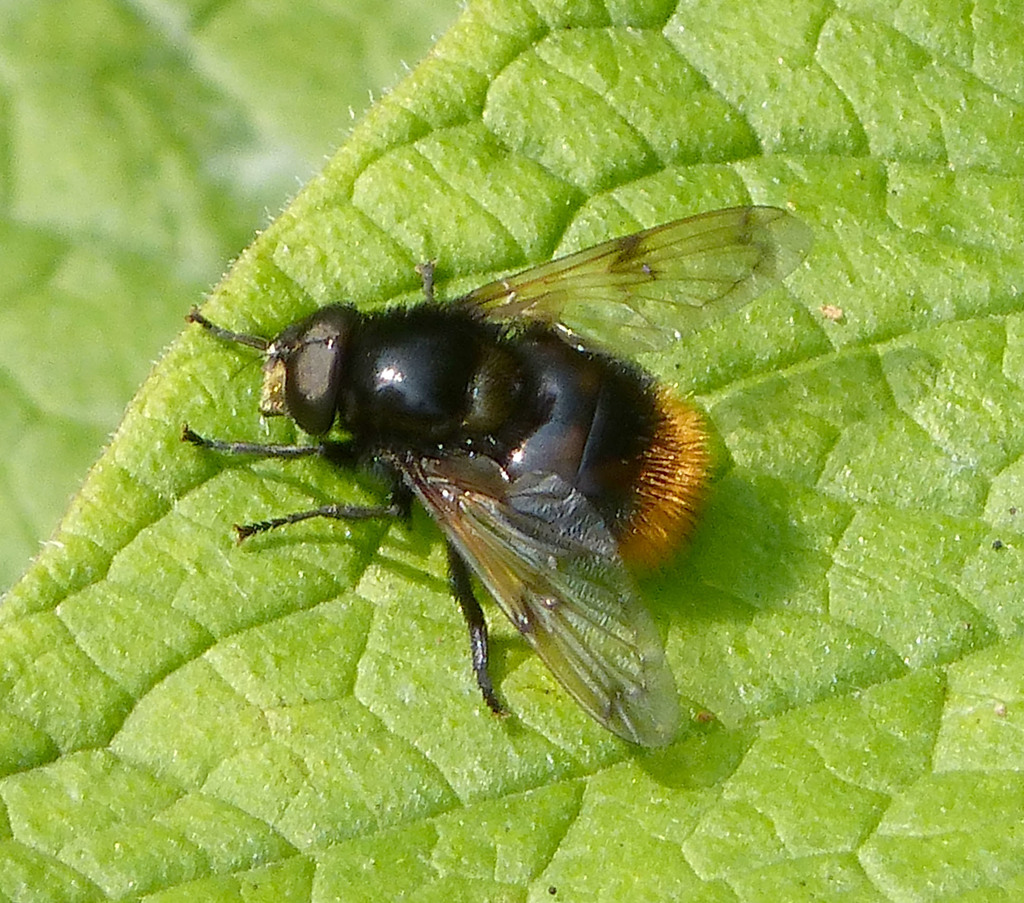
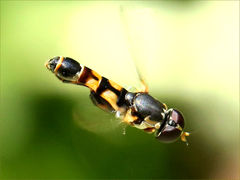
These flies look like bumblebees but have fly-like heads, plumed antennae and distinctive wing patterns. Adults feed on nectar and pollen from a variety of flowers, while females lay eggs in wasp or bumblebee nests where the larvae scavenge.
Source: Wikipedia
How to recognize it
They have a furry black, yellow or white body, plumed antennae, large eyes and a wing venation that marks them as true flies. The thorax has black or yellow side hairs, the scutellum is brownish or yellowish, and the wings are milky with dark cross-bands and a tip spot. The abdomen is yellow at the base, black in the middle, with dense hairs at the end; legs are short and black.
Source: Wikipedia
Size
Body length ranges from 11 to 17 mm, with a wingspan of about 8 to 14 mm, making it larger than most hoverflies.
Source: Wikipedia
What it eats
Adults visit blue flowers for nectar and pollen, especially Valeriana, Geranium, Centaurea, Cirsium, and Epilobium species. Females lay eggs in social wasp or bumblebee nests; larvae feed on nest debris and occasionally on host larvae.
Source: Wikipedia
Life cycle
Two generations occur from May to September, with a peak in June.
Source: Wikipedia
When you see it
Adults are most common in June but can be seen through the summer months.
Source: Wikipedia
Where it comes from
Present across most of Europe, the East Palearctic, the Near East and the Nearctic regions.
Source: Wikipedia
Lookalikes
Two main varieties mimic different bumblebee species: var. bombylans has an orange-red tail like Bombus lapidarius, var. plumata has a white tail like Bombus lucorum or Bombus terrestris. Other similar syrphids include Arctophila bombiformis and Merodon equestris.
Source: Wikipedia
Where it is found in the US
Recorded in 9 of 51 states and DC. Most records: Alaska, Pennsylvania, California, Colorado, Massachusetts, New Hampshire, Oregon, South Carolina.
Darker = more records. Counts are museum and citizen-science records, not population size.
Source: GBIF
Months it is reported in the US
Source: GBIF
Questions people ask
How can I tell them apart from real bumblebees?
Look for fly features such as plumed antennae, large eyes and the distinctive wing pattern with dark cross-bands.
Source: Wikipedia
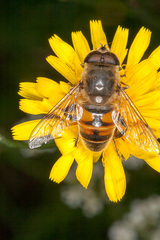
Same family (Syrphidae)


Sources
- Wikipedia: https://en.wikipedia.org/wiki/Volucella_bombylans
Look it up elsewhere: GBIF · iNaturalist · BugGuide · ITIS · Wikipedia
Text written 2026-10-22 from the sources above and checked sentence by sentence against them. Data fetched 2026-10-22.