 Bug FAQ
Bullet Ant
Paraponera clavata · Order: Hymenoptera · Family: Formicidae
Source: Wikipedia

Workers are 18 to 30 mm long and look like stout, reddish-black wingless wasps. They live in colonies of several hundred at the bases of trees in humid lowland rainforests of Central and South America, foraging in the canopy for small arthropods and nectar. Their sting ranks highest on the Schmidt pain index and is described as waves of burning, throbbing pain that can last up to a day.
Source: Wikipedia
How to recognize it
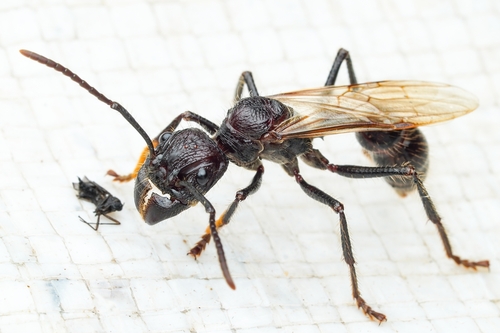
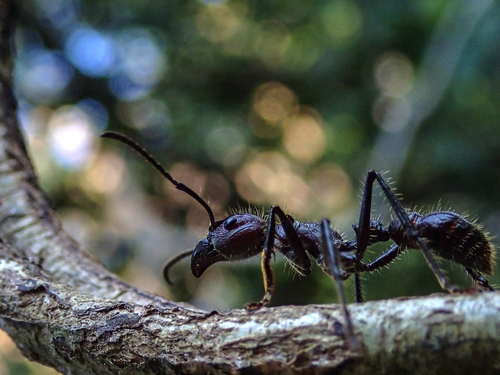
Workers resemble stout, reddish-black wingless wasps.
Source: Wikipedia
Does it bite or sting?
The sting rates 4.0+ on the Schmidt pain index, the highest of any insect. Sting pain is described as burning, throbbing waves that can last up to 24 hours.
Source: Wikipedia
Where it lives
Colonies of several hundred are usually found at the bases of trees. Foragers search the canopy and upper forest layers for small arthropods and nectar, rarely on the forest floor.
Source: Wikipedia
What it eats
Foragers commonly bring back nectar to the nest. They also prey on the glasswing butterfly (Greta oto).
Source: Wikipedia
Life cycle
The species shows no worker polymorphism; the queen is only slightly larger than workers.
Source: Wikipedia
Where it comes from
They inhabit humid lowland rainforests throughout Central and South America.
Source: Wikipedia
Lookalikes
Myrmecia ants (bull or bulldog ants) also have powerful stings.
Source: Wikipedia
Status: native in North America. Source: iNaturalist
More photos

Questions people ask
How painful is a bullet ant sting?
It is rated the most painful insect sting, causing burning, throbbing pain that can last a full day.
Source: Wikipedia
Where do bullet ants live?
They build colonies at tree bases in humid lowland rainforests of Central and South America and forage mainly in the canopy.
Source: Wikipedia
What do bullet ants eat?
Foragers bring back nectar and also hunt small arthropods such as the glasswing butterfly.
Source: Wikipedia
Same family (Formicidae)
 Eastern Black Carpenter AntCamponotus pennsylvanicusCan damage your home
 Red Imported Fire AntSolenopsis invictaCan sting
 American Winter AntPrenolepis imparis
 Argentine AntLinepithema humileNuisance, not dangerous
 Immigrant Pavement AntTetramorium immigransCan sting
 Odorous House AntTapinoma sessileCan damage your home
Sources
- Wikipedia: https://en.wikipedia.org/wiki/Paraponera_clavata
Look it up elsewhere: GBIF · iNaturalist · BugGuide · ITIS · Wikipedia
Text written 2026-10-23 from the sources above and checked sentence by sentence against them. Data fetched 2026-10-22.