 Bug FAQ
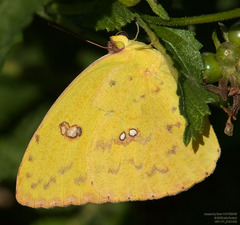
Broad-bordered Grass Yellow
Eurema brigitta · Order: Lepidoptera · Family: Pieridae
Also called: Broadbordered Grass Yellow, No Brand Grass Yellow, Small Grass Yellow
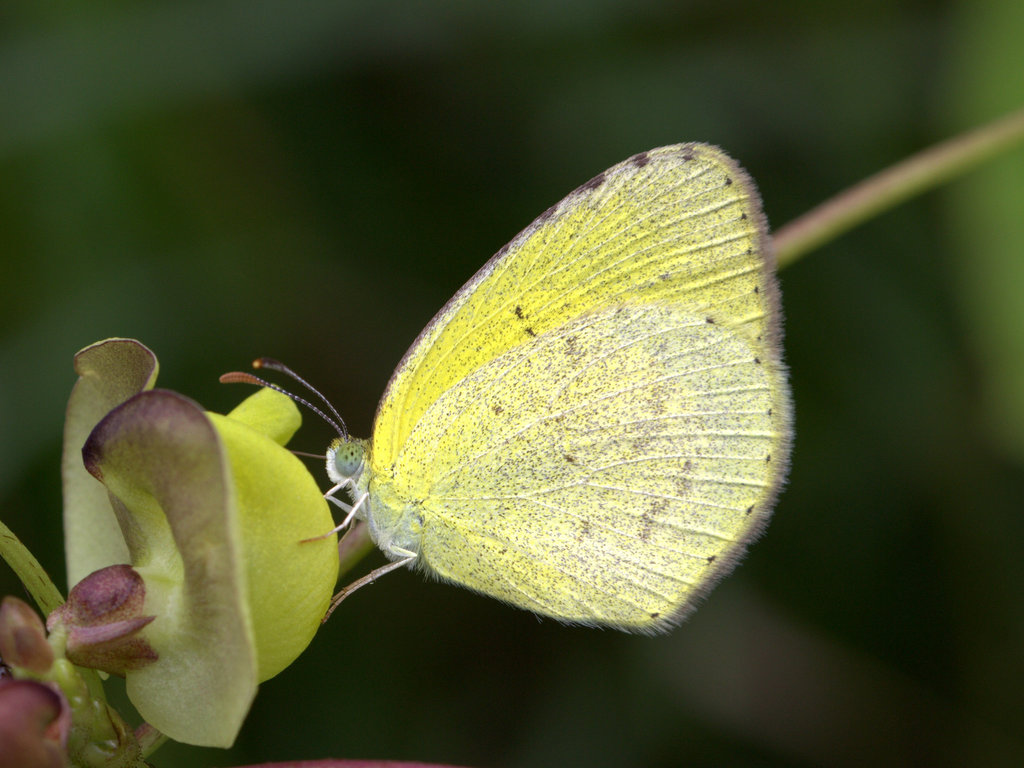
The broad-bordered grass yellow has a wingspan of about 30 to 35 mm. It lives in India and other parts of Asia, Australia and Africa. Its caterpillars feed on Hypericum aethiopicum and Chamaecrista mimosoides.
Source: Wikipedia
How to recognize it
In the wet season, males have a paler yellow upper side, a black outer marginal band on the fore-wing, rosy-red costa edge and cilia, and a narrower, macular black band on the hind-wing.
Source: Wikipedia
Size
Wingspan ranges from 30 to 35 mm.
Source: Wikipedia
Where it lives
Found across India, other Asian regions, Australia and Africa.
Source: Wikipedia
What it eats
Larvae eat the plants Hypericum aethiopicum and Chamaecrista mimosoides.
Source: Wikipedia
Life cycle
Adults can be seen flying throughout the whole year.
Source: Wikipedia
When you see it
Adults are on the wing year-round.
Source: Wikipedia
Lookalikes
It is a small butterfly in the Pieridae family, also called the small grass yellow.
Source: Wikipedia
Where it is found in the US
Recorded in 2 of 51 states and DC. Most records: Georgia, California.
Darker = more records. Counts are museum and citizen-science records, not population size.
Source: GBIF
Questions people ask
When can I see adult butterflies?
Adults are on the wing throughout the entire year.
Source: Wikipedia
How big is the broad-bordered grass yellow?
Its wingspan measures about 30 to 35 mm.
Source: Wikipedia
Same family (Pieridae)


Sources
- Wikipedia: https://en.wikipedia.org/wiki/Eurema_brigitta
Look it up elsewhere: GBIF · iNaturalist · BugGuide · Wikipedia
Text written 2026-10-23 from the sources above and checked sentence by sentence against them. Data fetched 2026-10-22.