 Bug FAQ
Broad-barred Brusheye
Dasysyrphus venustus · Order: Diptera · Family: Syrphidae
Also called: Broad-barred Fleckwing, Transverse Conifer Fly
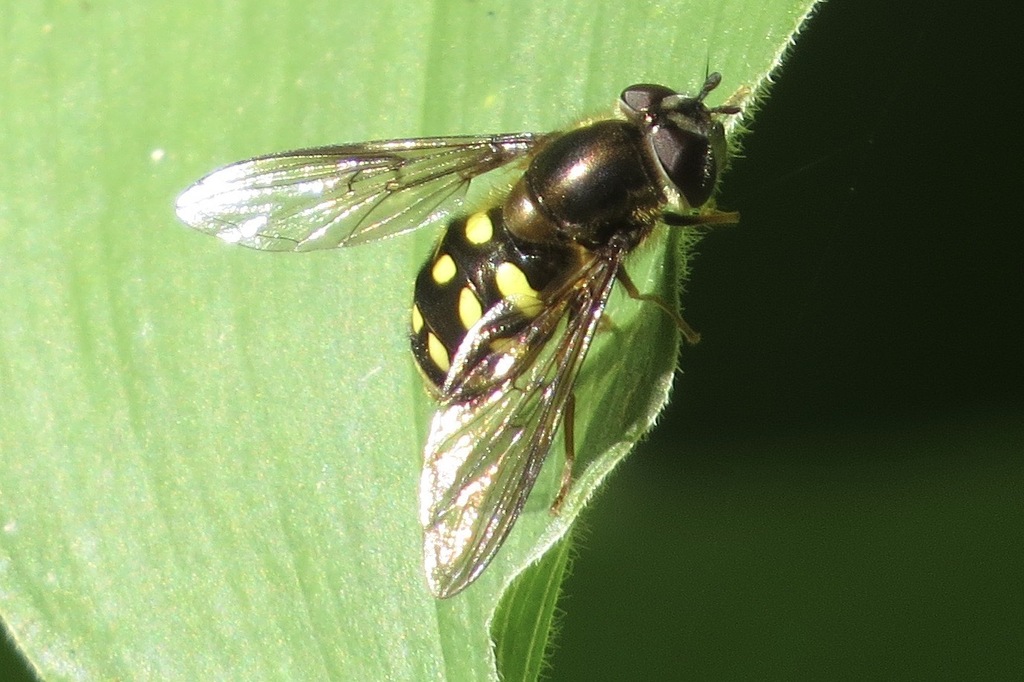
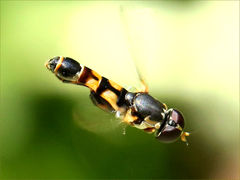
The Dasysyrphus venustus flies have a wing length between about 6.3 and 10 mm. Their abdomen shows equal yellow patches on tergites 3 and 4, and a broad pale pattern on tergite 2 that is at least as wide as the others. They live in a variety of forests to beech, oak, birch, pine, spruce and fir to and can be found in clearings and tracksides, often visiting white umbellifer flowers. Their range covers the Palaearctic region from Fennoscandia down to northern Spain, across Ireland and central Europe, through the mountains of Italy and the Balkans, and eastward to the Russian Far East and the Pacific coast. Adults are on the wing from April to June, later at higher elevations and more northern latitudes.
Source: Wikipedia
How to recognize it
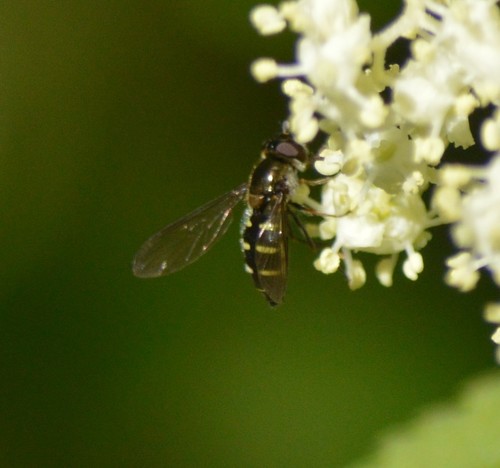
Tergites 3 and 4 have yellow markings of the same size, and tergite 2 bears a pale pattern that is as broad or broader than those on the next segments. The face features a distinct black longitudinal stripe.
Source: Wikipedia
Size
Wing length ranges from 6.25 mm to 10 mm.
Source: Wikipedia
Where it lives
Found in beech, oak and birch woodlands, alluvial deciduous forests, as well as pine, spruce and fir forests, often in clearings and along tracks.
Source: Wikipedia
Life cycle
Adults fly from April through June, with later emergence at higher altitudes and latitudes.
Source: Wikipedia
When you see it
The flight period is April to June, shifting later in mountainous or northern areas.
Source: Wikipedia
Where it comes from
Native to the Palaearctic, from Fennoscandia south to northern Spain, across Ireland and central Europe, through the mountains of Italy and the former Yugoslavia, and east to the Russian Far East and Siberia up to the Kuril Islands.
Source: Wikipedia
Where it is found in the US
Recorded in 14 of 51 states and DC. Most records: Alaska, North Carolina, New Mexico, Illinois, Virginia, Pennsylvania, Vermont, Georgia.
Darker = more records. Counts are museum and citizen-science records, not population size.
Source: GBIF
Months it is reported in the US
Source: GBIF
More photos
Questions people ask
When are Dasysyrphus venustus adults active?
Adults are on the wing from April to June, and appear later in higher or more northern locations.
Source: Wikipedia
Same family (Syrphidae)


Sources
- Wikipedia: https://en.wikipedia.org/wiki/Dasysyrphus_venustus
Look it up elsewhere: GBIF · iNaturalist · BugGuide · ITIS · Wikipedia
Text written 2026-10-28 from the sources above and checked sentence by sentence against them. Data fetched 2026-10-28.