 Bug FAQ
Brindled Beauty Moth
Lycia hirtaria · Order: Lepidoptera · Family: Geometridae
Also called: Brindled Beauty
Source: Wikipedia
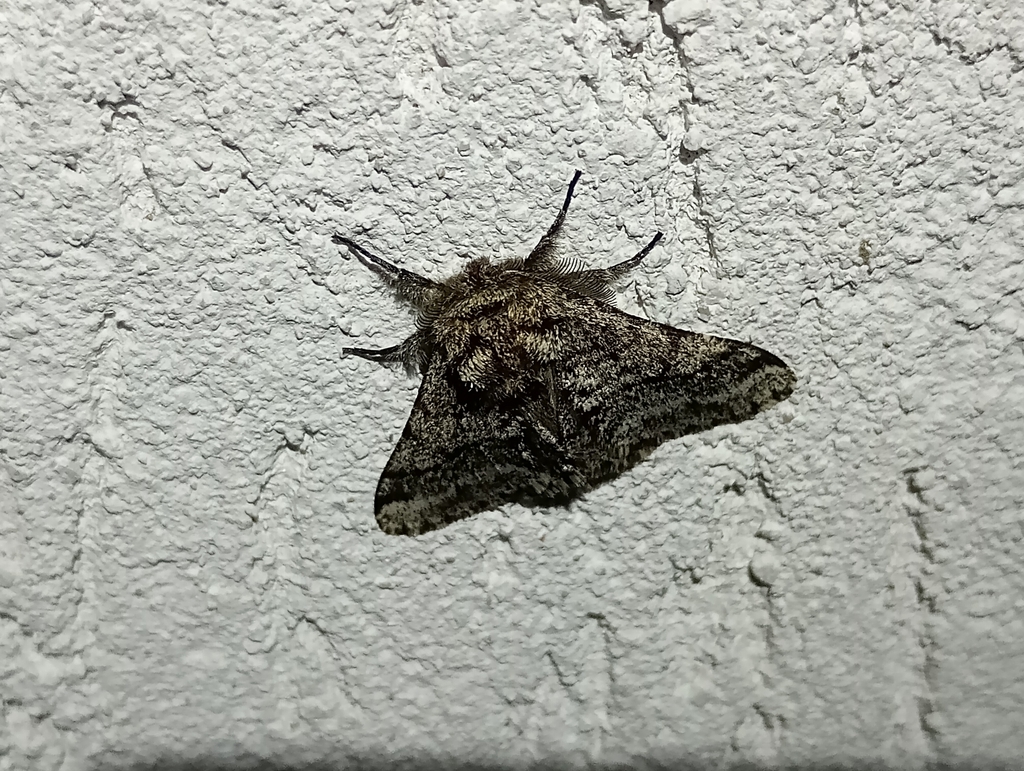
The Brindled Beauty moth has a wingspan of about 4 to 5 cm and a furry, camouflaged body that blends with tree trunks. It lives in woodlands and suburban areas across most of Europe to Japan, and flies from March to late May, attracted to light at night. Its caterpillars are polyphagous, feeding in late spring on the leaves of broad-leaved trees and deciduous shrubs.
Source: Wikipedia
How to recognize it
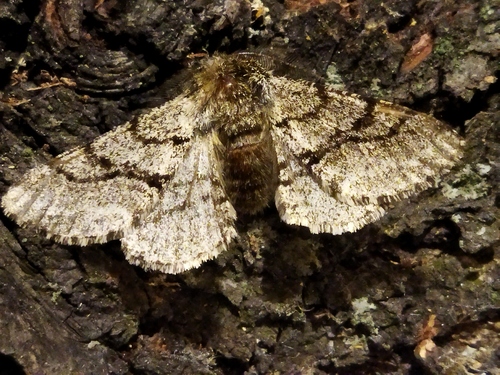
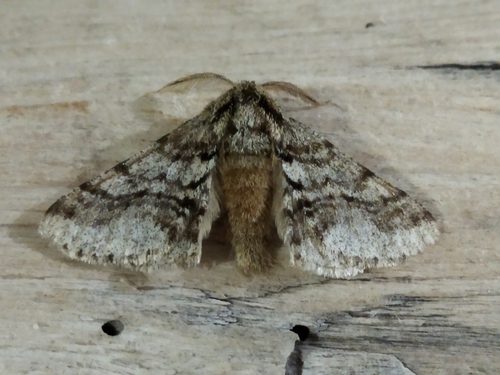
The moth is large-bodied and furry, with a pattern that gives near-perfect camouflage on tree trunks. The forewings are generally grey with black dusting.
Source: Wikipedia
Size
Wingspan ranges from 4 to 5 cm.
Source: Wikipedia
Where it lives
It prefers woodland and suburban habitats.
Source: Wikipedia
What it eats
Caterpillars are polyphagous, feeding mainly in late spring on broad-leaved trees and deciduous shrubs. Adults are nocturnal.
Source: Wikipedia
Life cycle
Eggs are ellipsoid, micropylar, slightly concave and granulated, with a glossy surface visible under strong magnification. The pupa overwinters.
Source: Wikipedia
Where it comes from
Found throughout most of Europe, Russia, the Caucasus, Asia Minor, Siberia, the Russian Far East, Sakhalin and Japan.
Source: Wikipedia
Lookalikes
The female-ab. terroraria form is uniformly grey with faint vein lines on the forewing. The female-ab. fumaria form is smoky black or fuscous, sometimes completely unmarked.
Source: Wikipedia
Where it is found in the US
Recorded in 1 of 51 states and DC. Most records: Pennsylvania.
Darker = more records. Counts are museum and citizen-science records, not population size.
Source: GBIF
More photos
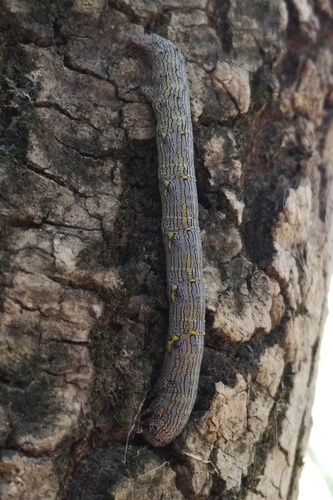
Questions people ask
When are these moths active?
They fly from March through the end of May and are attracted to light at night.
Source: Wikipedia
What do the caterpillars eat?
They feed on the leaves of broad-leaved trees and deciduous shrubs in late spring.
Source: Wikipedia
Where can I find Brindled Beauty moths?
They occur in woodlands and suburban areas across most of Europe to Japan.
Source: Wikipedia
Same family (Geometridae)
 Willow BeautyPeribatodes rhomboidaria
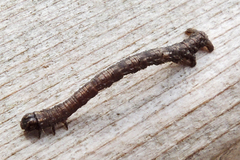 Pale BeautyCampaea perlataDamages trees, gardens or crops
 Large Lace-border MothScopula limboundataDamages trees, gardens or crops
 Riband WaveIdaea aversata
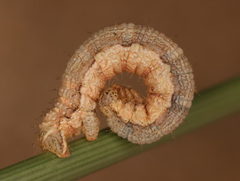 Yellow Shell MothCamptogramma bilineata
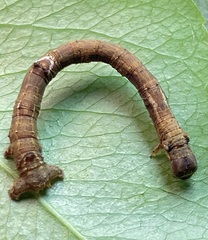 Large Maple Spanworm MothProchoerodes lineolaDamages trees, gardens or crops
Sources
- Wikipedia: https://en.wikipedia.org/wiki/Brindled_beauty
Look it up elsewhere: GBIF · iNaturalist · BugGuide · Wikipedia
Text written 2026-10-22 from the sources above and checked sentence by sentence against them. Data fetched 2026-10-22.