 Bug FAQ
Bogong Moth
Agrotis infusa · Order: Lepidoptera · Family: Noctuidae
Source: Wikipedia

Bogong moths are medium-sized night moths with a dark brown body and a distinctive wing pattern of a dark stripe broken by two light spots. They breed in southern Australia during autumn and winter, the larvae feed on many pasture and garden plants, and the adults migrate to the Australian Alps in summer. Heavy outbreaks can harm crops, and control measures include turning off lights and using insecticides, though urban use is limited.
Source: Wikipedia
How to recognize it
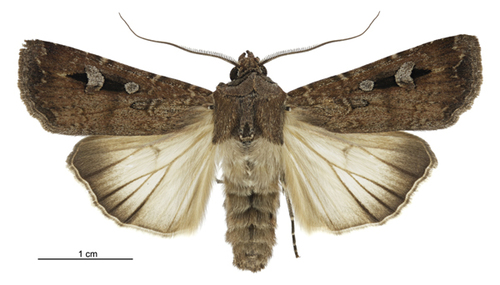
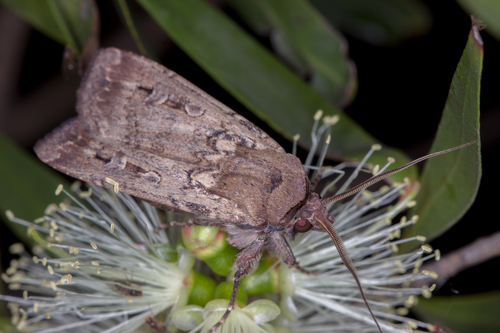
Adults are dark brown with a dark stripe on the wings that is interrupted by two light spots. Migratory moths have brown hind wings, while non-migratory ones have paler hind wings.
Source: Wikipedia
Size
The wingspan is about 40 to 50 mm and the body length is roughly 25 to 35 mm. Larvae can grow up to 50 mm long.
Source: Wikipedia
Is it a pest in the house?
The bogong moth is a minor, irregular pest of crops in Australia. When outbreaks are severe, insecticides are applied to affected crops.
Source: Wikipedia
How to get rid of it
Control attempts include turning off lights, covering attractive indoor corners, and using insecticides, though urban use has been reduced due to environmental concerns.
Source: Wikipedia
Where it lives
Eggs and larvae are found in self-mulching soils and crop pastures where food is abundant in autumn and winter. In spring and summer, when grasses dominate pastures, conditions become unsuitable for larvae.
Source: Wikipedia
What it eats
Adult moths breed in winter and the larvae feed on winter pasture plants. Recorded host plants include Medicago, wheat, cabbages, cauliflower, silver beet, peas and potatoes.
Source: Wikipedia
Life cycle
It can produce several generations per year.
Source: Wikipedia
When you see it
During spring the moths migrate south or east to alpine areas like Mount Bogong, where they aestivate through summer before returning to breeding grounds in autumn.
Source: Wikipedia
Where it comes from
The species lives in temperate southern Australia, mainly west of the Great Dividing Range. It migrates long distances between breeding grounds and the Australian Alps each year.
Source: Wikipedia
Lookalikes
Migratory and non-migratory forms differ in hind-wing colour: brown for migratory, paler for non-migratory.
Source: Wikipedia
More photos
Questions people ask
What crops can bogong moth larvae damage?
They can feed on and damage wheat, cabbages, cauliflower, silver beet, peas and potatoes.
Source: Wikipedia
How can I keep bogong moths out of my house?
Turn off lights, cover bright indoor corners and pathways, and avoid using insecticides indoors.
Source: Wikipedia
Same family (Noctuidae)
 Ipsilon Dart MothAgrotis ipsilonDamages trees, gardens or crops
 Fall Armyworm MothSpodoptera frugiperdaDamages trees, gardens or crops
 Army Cutworm MothEuxoa auxiliarisDamages trees, gardens or crops
 Large Yellow UnderwingNoctua pronubaDamages trees, gardens or crops
 Silver ΥAutographa gamma
 American DaggerAcronicta americanaCan irritate skin
Sources
- Wikipedia: https://en.wikipedia.org/wiki/Bogong_moth
Look it up elsewhere: GBIF · iNaturalist · BugGuide · Wikipedia
Text written 2026-10-22 from the sources above and checked sentence by sentence against them. Data fetched 2026-10-22.