 Bug FAQ
Blood-red Field Ant
Formica sanguinea · Order: Hymenoptera · Family: Formicidae
Also called: Blood-Red Ant, Blood-red Slave-making Ant, Slave-making Ant, Slavemaker ant

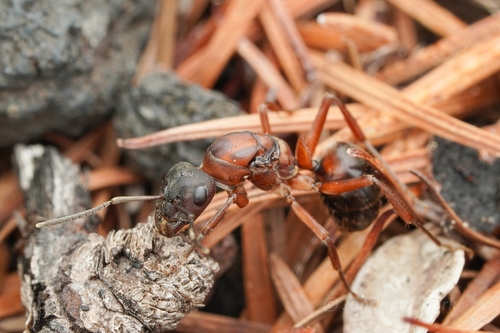
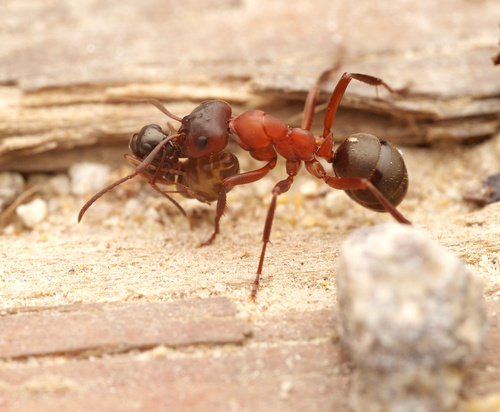
Workers are red and black and grow up to about 7 mm long (size and markings). Colonies may live on their own or as parasites of other Formica ants, and they raid nearby nests to steal larvae and pupae. They are found from central and northern Europe across Russia to Japan, China, Korea, Africa and the United States.
Source: Wikipedia
How to recognize it
The ant is red and black in colour.
Source: Wikipedia
Size
Workers can reach up to 7 mm in length.
Source: Wikipedia
Does it bite or sting?
They can secrete formic acid.
Source: Wikipedia
Where it lives
A colony can exist freely or as a social parasite of other Formica species such as F. fusca, F. japonica, F. hayashi and F. rufibarbis.
Source: Wikipedia
Life cycle
Most colonies have a single queen (monogynous). The queen mates with multiple males (polyandrous).
Source: Wikipedia
When you see it
Raids are not observed on rainy or overcast days.
Source: Wikipedia
Where it comes from
Its range includes central and northern Europe, Russia, Japan, China, the Korean Peninsula, Africa and the United States.
Source: Wikipedia
Where it is found in the US
Recorded in 18 of 51 states and DC. Most records: Colorado, Minnesota, Nevada, Oregon, California, Montana, Arizona, Wisconsin.
Darker = more records. Counts are museum and citizen-science records, not population size.
Source: GBIF
Months it is reported in the US
Source: GBIF
More photos
Questions people ask
Where might I find them?
They occur from central and northern Europe across Russia to Japan, China, Korea, Africa and the United States.
Source: Wikipedia
Same family (Formicidae)
 Eastern Black Carpenter AntCamponotus pennsylvanicusCan damage your home
 Red Imported Fire AntSolenopsis invictaCan sting
 American Winter AntPrenolepis imparis
 Argentine AntLinepithema humileNuisance, not dangerous
 Immigrant Pavement AntTetramorium immigransCan sting
 Odorous House AntTapinoma sessileCan damage your home
Sources
- Wikipedia: https://en.wikipedia.org/wiki/Formica_sanguinea
Look it up elsewhere: GBIF · iNaturalist · BugGuide · ITIS · Wikipedia
Text written 2026-10-23 from the sources above and checked sentence by sentence against them. Data fetched 2026-10-22.