 Bug FAQ
Blackmound Termite
Amitermes hastatus · Order: Blattodea · Family: Termitidae
Also called: Black Mound Termite, Blackmound Love Termite
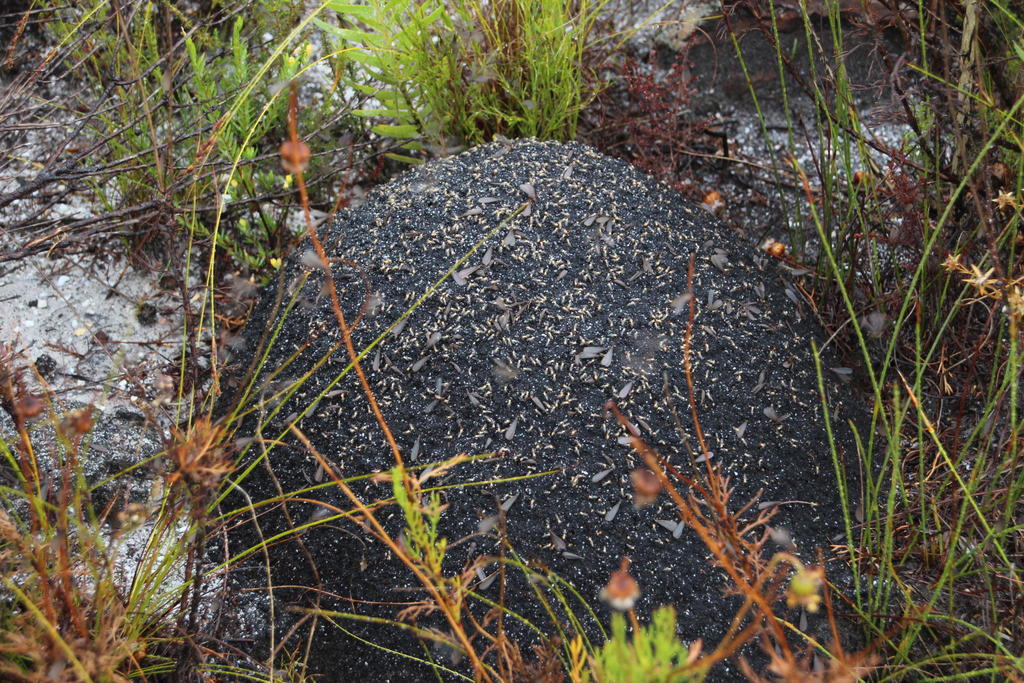
Workers are about 4 to 4.5 mm long and soldiers are a bit larger at 5 to 5.5 mm. They build black mounds up to 50 cm tall in the fynbos of South Africa’s Western Cape, usually on sandy soil from Table Mountain sandstone between 100 m and 900 m elevation. The colony feeds on humus and damp dead plant material underground, and mature mounds produce white nymphs that become alates for mating flights in April-May after autumn rains.
Source: Wikipedia
How to recognize it
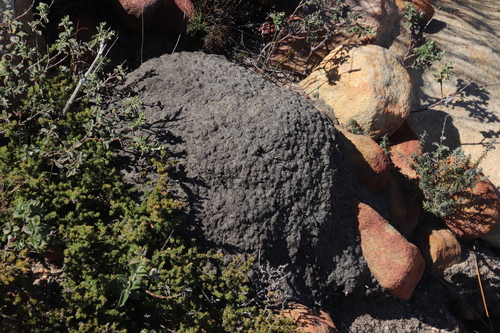
Their nests are distinctive black termite mounds ranging from a few centimeters to 50 cm high.
Source: Wikipedia
Size
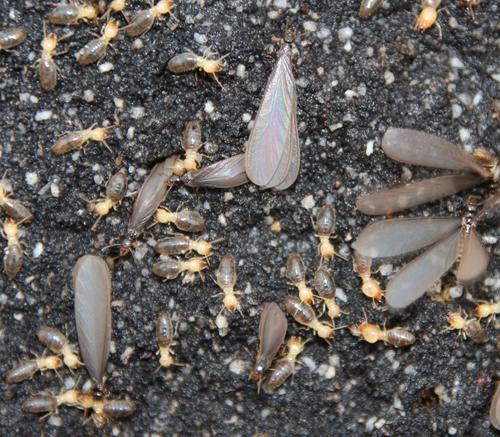
Worker termites measure 4 to 4.5 mm in length. Soldier termites are larger, 5 to 5.5 mm long.
Source: Wikipedia
Life cycle
Queens can grow to about 15 mm and move freely in the centre of the mound.
Source: Wikipedia
When you see it
Mating flights occur in April or May following the first autumn rains.
Source: Wikipedia
Where it comes from
The black mound termite is native to the Western Cape region of South Africa. It is endemic to the fynbos ecosystem.
Source: Wikipedia
Lookalikes
Termes winifredae often lives nearby as an inquiline, but if the two species clash, A. hastatus usually wins.
Source: Wikipedia
More photos


Questions people ask
What do the nests of black mound termites look like?
They are black, mound-shaped structures that can be a few centimeters tall up to about half a meter.
Source: Wikipedia
Where can I find black mound termites?
They are found in South Africa’s Western Cape fynbos, on sandy soil from roughly 100 m to 900 m elevation.
Source: Wikipedia
What do black mound termites eat?
They feed on humus and damp dead plant material underground.
Source: Wikipedia
Same family (Termitidae)


Sources
- Wikipedia: https://en.wikipedia.org/wiki/Amitermes_hastatus
Look it up elsewhere: GBIF · iNaturalist · BugGuide · Wikipedia
Text written 2026-10-23 from the sources above and checked sentence by sentence against them. Data fetched 2026-10-23.