 Bug FAQ
Black-thighed Flower Fly
Syrphus vitripennis · Order: Diptera · Family: Syrphidae
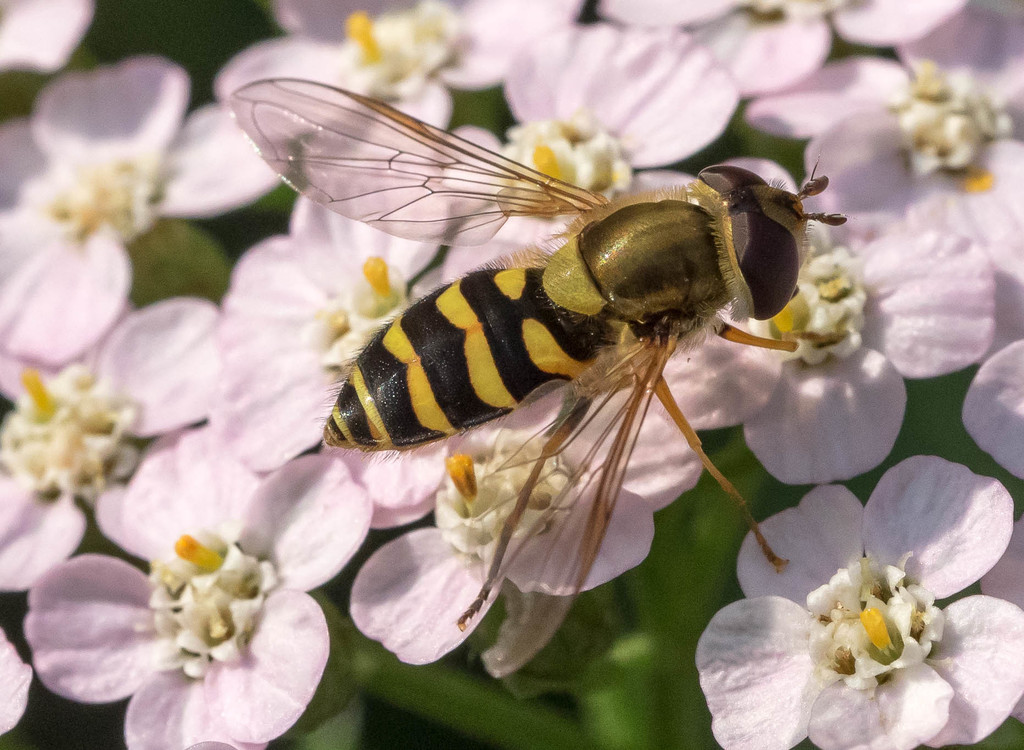
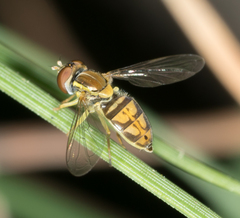
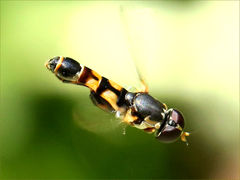
The black-thighed flower fly has wing lengths between about 7.3 and 10.3 mm and shows a black frons above the lunulae, yellow bands on abdominal segments three and four with black side margins, and black-colored femora on the basal portions (three-quarters in males, two-thirds in females). It lives in deciduous and coniferous woods, field hedges, suburban gardens and parks, and is found from Alaska to California in North America as well as across the Palearctic region. Its larvae feed on aphids, and adults are active from March through October.
Source: Wikipedia
How to recognize it
The top of the head (frons) above the lunulae is black. Abdominal segments three and four have full yellow bands with black on the side edges. Male femur three is black on the basal three-quarters of its length. Female femur three is black on the basal two-thirds of its length.
Source: Wikipedia
Size
Wing length ranges from about 7.25 mm to 10.25 mm.
Source: Wikipedia
Where it lives
It inhabits deciduous and coniferous woodlands, field hedges, suburban gardens and parks.
Source: Wikipedia
What it eats
The larvae feed on aphids.
Source: Wikipedia
When you see it
Adults are on the wing from March through October.
Source: Wikipedia
Where it comes from
In North America it occurs from Alaska down to California. It is also widespread throughout the Palearctic region.
Source: Wikipedia
Where it is found in the US
Recorded in 11 of 51 states and DC. Most records: Alaska, Pennsylvania, Massachusetts, Illinois, Colorado, Georgia, Maine, Maryland.
Darker = more records. Counts are museum and citizen-science records, not population size.
Source: GBIF
Status: native in North America; native in Canada. Source: iNaturalist
Months it is reported in the US
Source: GBIF
More photos
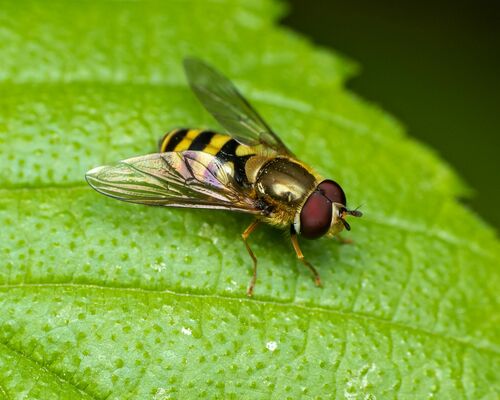
Same family (Syrphidae)


Sources
- Wikipedia: https://en.wikipedia.org/wiki/Syrphus_vitripennis
Look it up elsewhere: GBIF · iNaturalist · BugGuide · ITIS · Wikipedia
Text written 2026-10-26 from the sources above and checked sentence by sentence against them. Data fetched 2026-10-26.