 Bug FAQ
Black-horned Smoothtail
Epistrophe grossulariae · Order: Diptera · Family: Syrphidae
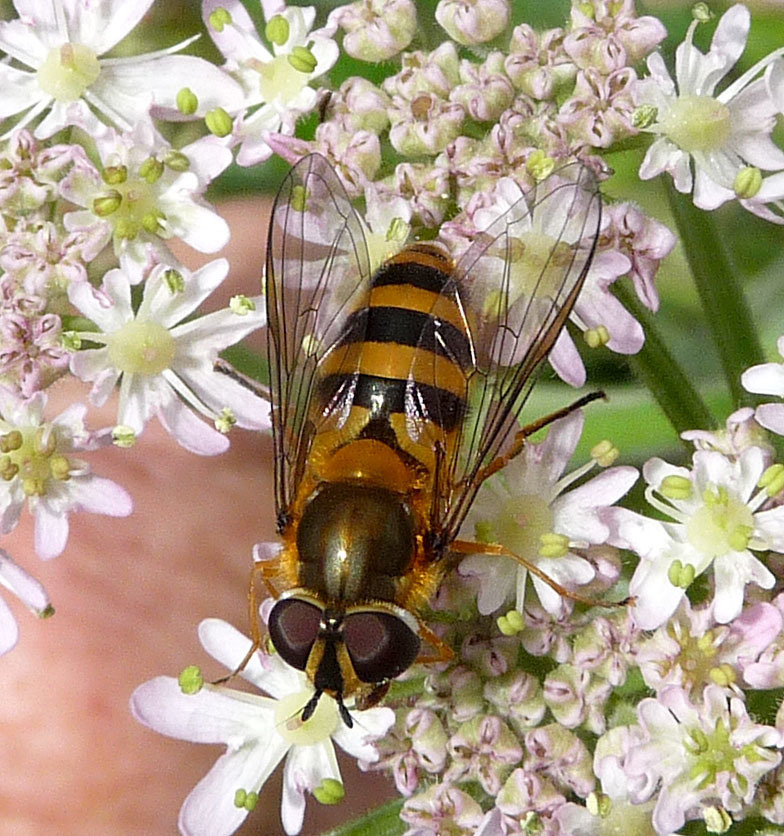
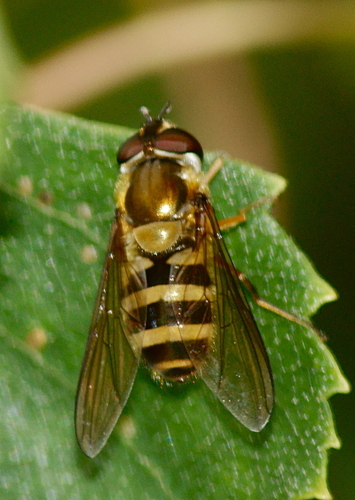
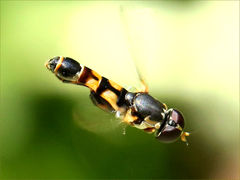
The Black-horned Smoothtail is a hoverfly with wing length about 9 to 12 mm and a dull greenish thorax; its fourth abdominal segment has a solid yellow band and the fifth a black band. It lives in deciduous woodlands, especially near rivers, streams, willow swamps and alpine grasslands, and can be seen in clearings and tracksides.
Source: Wikipedia
How to recognize it
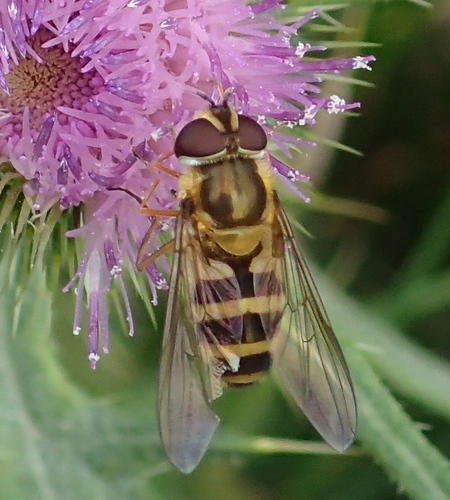
Thorax is dull greenish; the fourth tergite has an entire yellow band, the fifth a black band; tergites 3 and 4 have straight yellow bands; at least the front femora are dark at the base, sometimes the hind femora too; the frons is black above the lunule and at least half covered with black hairs; females show a bronzy-green area on the upper frons.
Source: Wikipedia
Size
Wing length ranges from 9 to 12 mm.
Source: Wikipedia
Where it lives
Found in deciduous woodland, especially along rivers and streams, willow swamp woodland, alpine grassland, clearings, tracksides and beside streams.
Source: Wikipedia
What it eats
Larvae feed on aphids.
Source: Wikipedia
Life cycle
Adults fly from late June through September.
Source: Wikipedia
When you see it
The flight period is late June to September.
Source: Wikipedia
Lookalikes
It is a Holarctic species of hoverfly.
Source: Wikipedia
Where it is found in the US
Recorded in 33 of 51 states and DC. Most records: Pennsylvania, North Carolina, Maine, Virginia, Vermont, Alaska, New York, Massachusetts.
Darker = more records. Counts are museum and citizen-science records, not population size.
Source: GBIF
Status: native in North America; native in Canada. Source: iNaturalist
Months it is reported in the US
Source: GBIF
More photos
Questions people ask
When are Black-horned Smoothtail hoverflies active?
Adults are on the wing from the end of June until September.
Source: Wikipedia
Same family (Syrphidae)


Sources
- Wikipedia: https://en.wikipedia.org/wiki/Epistrophe_grossulariae
Look it up elsewhere: GBIF · iNaturalist · BugGuide · ITIS · Wikipedia
Text written 2026-10-22 from the sources above and checked sentence by sentence against them. Data fetched 2026-10-22.