 Bug FAQ
Black-headed Sugar Ant
Camponotus nigriceps · Order: Hymenoptera · Family: Formicidae
Source: Wikipedia
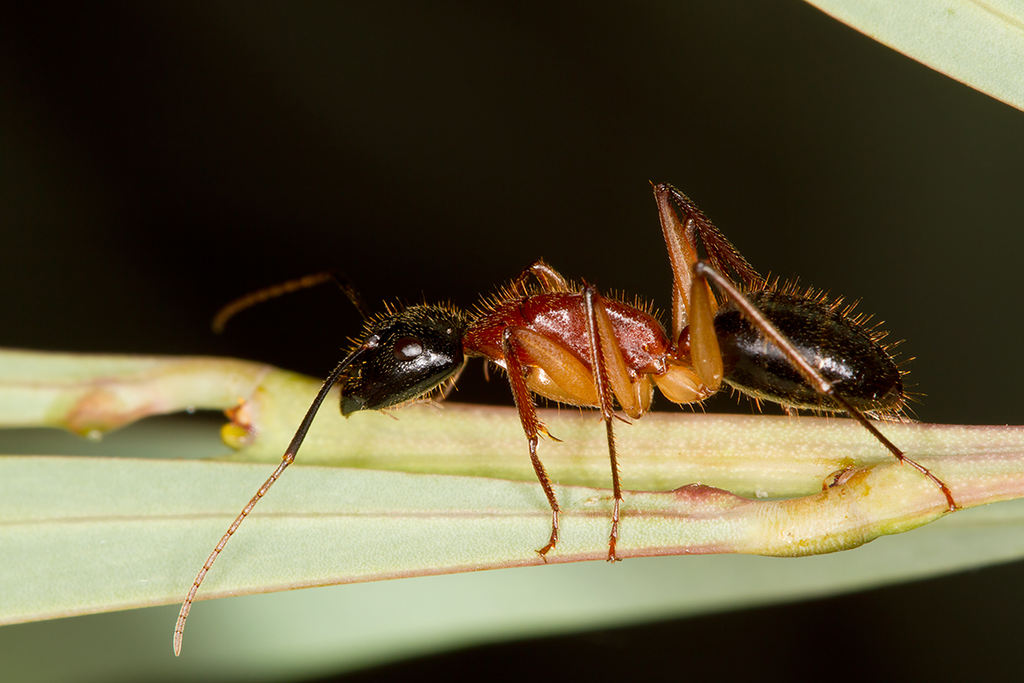
Black-headed sugar ants have a black head, reddish-brown middle, and a black abdomen that may change colour. Workers are 6 to 12 mm long, queens reach about 16 mm, and males are about 12 mm. Colonies live in dry open areas or dry sclerophyll woodlands, nesting in soil, mounds or under stones, and can number several thousand ants.
Source: Wikipedia
How to recognize it
They are identified by a black head, reddish-brown mesosoma and a black gaster that can change colour. Workers are mostly brown with lighter patches on the head and mesosoma; their clypeus and mandibles are darker, and legs are black or brown.
Source: Wikipedia
Size
Workers and soldiers measure 6 to 12 mm; males are about 12 mm; queens are the largest at 16 mm.
Source: Wikipedia
Is it a pest in the house?
They are considered a household pest because they enter homes at night in search of food.
Source: Wikipedia
How to get rid of it
They forage at night and may enter homes for food; workers use pheromone trails, tandem running or carry each other to move the colony or locate food.
Source: Wikipedia
Where it lives
They live in dry regions, especially open areas or dry sclerophyll woodland, nesting in soil, large mounds or under stones.
Source: Wikipedia
What it eats
They mainly feed on sweet secretions, sugar water, insects and other food found in homes.
Source: Wikipedia
Life cycle
Nuptial flights occur in summer and colonies can contain five to seven thousand individuals.
Source: Wikipedia
When you see it
Nuptial flights most likely begin in summer, with young queens found in January.
Source: Wikipedia
Where it comes from
The species is endemic to Australia, found in north and south-east Queensland and throughout the Australian Capital Territory.
Source: Wikipedia
Lookalikes
They can be confused with the banded sugar ant, which has a darker band around the gaster that this species lacks.
Source: Wikipedia
Questions people ask
How can I prevent them from entering my house?
Seal cracks and keep food stored in airtight containers, as they are attracted to sweet foods at night.
Source: Wikipedia
What do they look like?
They have a black head, reddish-brown middle body and a black abdomen, with workers showing brown bodies and darker mandibles.
Source: Wikipedia
Where are they found?
They are native to dry regions of Australia, especially in Queensland and the Australian Capital Territory.
Source: Wikipedia
Same family (Formicidae)
 Eastern Black Carpenter AntCamponotus pennsylvanicusCan damage your home
 Red Imported Fire AntSolenopsis invictaCan sting
 American Winter AntPrenolepis imparis
 Argentine AntLinepithema humileNuisance, not dangerous
 Immigrant Pavement AntTetramorium immigransCan sting
 Odorous House AntTapinoma sessileCan damage your home
Sources
- Wikipedia: https://en.wikipedia.org/wiki/Black-headed_sugar_ant
Look it up elsewhere: GBIF · iNaturalist · BugGuide · ITIS · Wikipedia
Text written 2026-10-23 from the sources above and checked sentence by sentence against them. Data fetched 2026-10-23.