 Bug FAQ
Black-banded Hover Fly
Episyrphus viridaureus · Order: Diptera · Family: Syrphidae
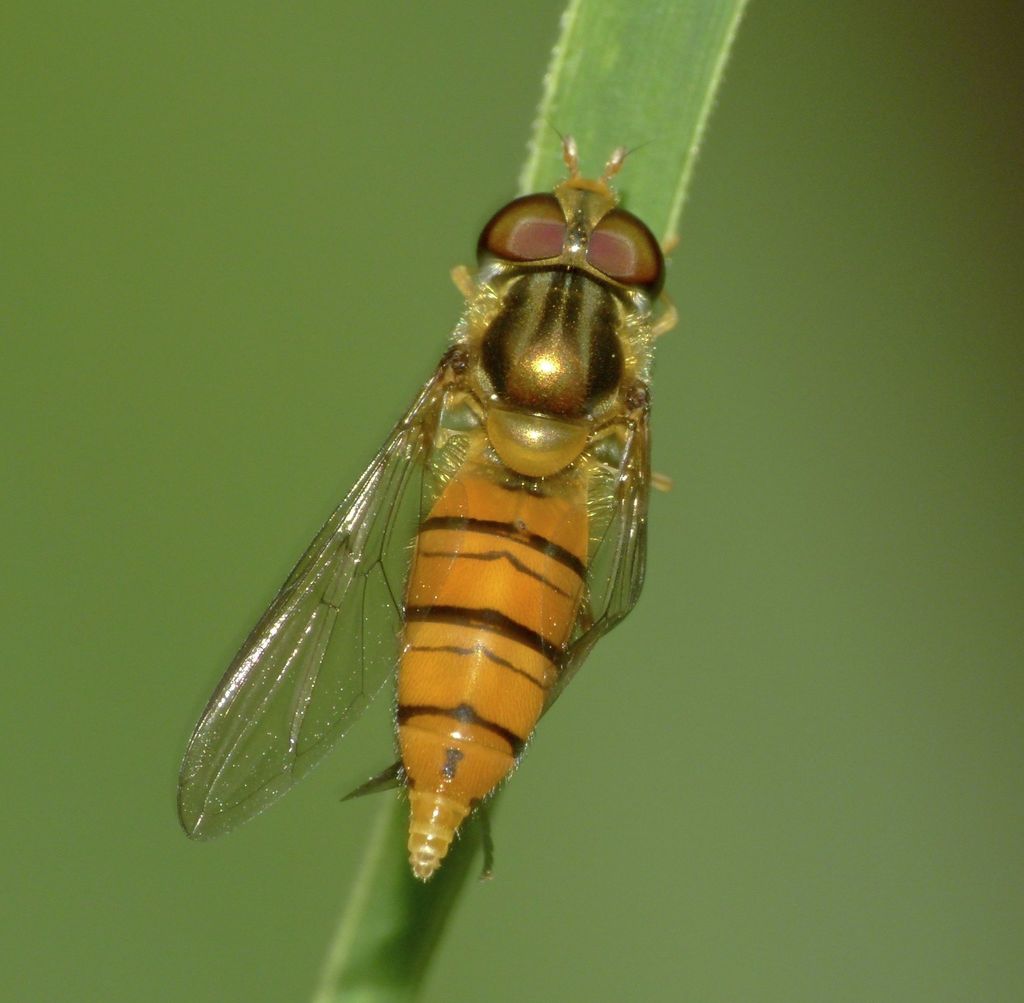
The black-banded hoverfly is orange-yellow with narrow dark bands on its abdomen and a metallic black shield on the thorax, plus a blue spot between its purple eyes. It measures about 10 to 20 mm, sometimes up to 35 mm. It lives in disturbed or suburban areas across eastern Australia, parts of Southeast Asia, Malaysia, Indonesia, New Caledonia and India.
Source: Wikipedia
How to recognize it
Orange-yellow body with narrow dark abdominal bands. Thorax dorsum covered by a metallic black shield, rest covered in orange-yellow hair. Metallic blue area on the forehead between dark purple eyes.
Source: Wikipedia
Size
Length typically 10 to 20 mm, can reach up to 35 mm.
Source: Wikipedia
Where it lives
Found in disturbed or suburban environments.
Source: Wikipedia
Life cycle
Females lay eggs on plants like Ageratum houstonianum and Sonchus oleraceus.
Source: Wikipedia
Where it comes from
Occurs on Australia’s east coast from northern Queensland to south of Sydney, and also in Malaysia, Indonesia, New Caledonia, India and Southeast Asia.
Source: Wikipedia
Questions people ask
What do the larvae eat?
The larvae eat several species of aphids, including Brachybaudus helichrysi and Aphis gossypii.
Source: Wikipedia
Where might I find this hoverfly?
It is common in disturbed or suburban areas across eastern Australia and parts of Southeast Asia.
Source: Wikipedia
How big does this hoverfly get?
Adults are usually 10 to 20 mm long but can grow up to 35 mm.
Source: Wikipedia
What plants do females lay their eggs on?
Eggs are often laid on Ageratum houstonianum and Sonchus oleraceus.
Source: Wikipedia
Same family (Syrphidae)






Sources
- Wikipedia: https://en.wikipedia.org/wiki/Episyrphus_viridaureus
Look it up elsewhere: GBIF · iNaturalist · BugGuide · Wikipedia
Text written 2026-10-23 from the sources above and checked sentence by sentence against them. Data fetched 2026-10-22.