 Bug FAQ
Bare-winged Aphideater
Eupeodes perplexus · Order: Diptera · Family: Syrphidae
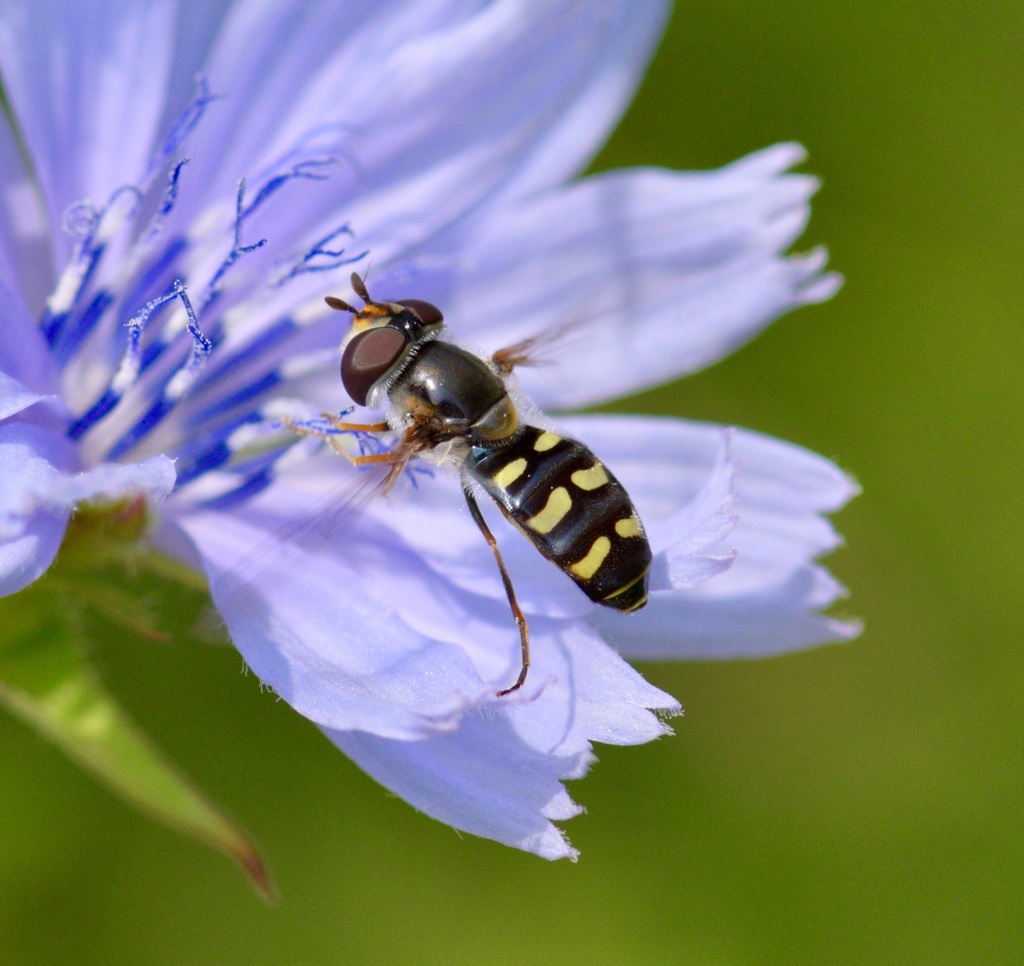
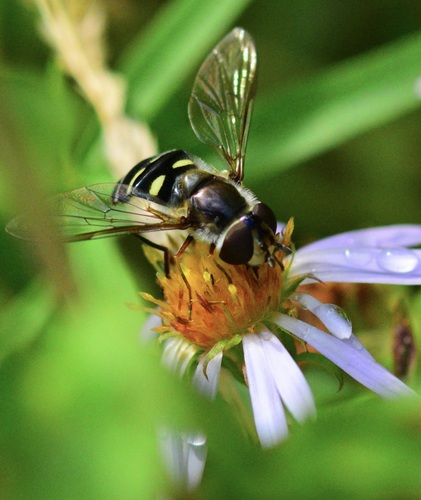
The Bare-winged Aphideater has a hemispherical head with a pale, slightly concave face and black cheeks, and its third antennal segment is unusually large and oval. Its abdomen shows yellow, finger-like spots that are curved and interrupted in the middle, with broader bands in females. The wings are clear, the third longitudinal vein is only slightly curved, and the stigma is a thin, long brown mark.
Source: Wikipedia
How to recognize it
The face is pale, slightly concave below the antennae, with black cheeks and a dark median stripe over a tubercle. The third antennal segment (flagellum) is exceptionally large and oval. The scutellum is raised, exposing the metanotum. The anterior anepisternum, meron, and metepisternum lack pile. Males have yellow, black, or mixed pile on the scutellum, while females have mostly black pile there. The first abdominal segment is very narrow and entirely black. Spots on segments three and four are slightly lunate, and the posterior margins of the fourth and fifth segments are narrowly yellow. Legs are mainly pale reddish, with black bases on the femora and the hind femora black on at least the basal half.
Source: Wikipedia
What it eats
Adults feed on nectar, while the larvae prey on aphids and scale insects.
Source: Wikipedia
Where it comes from
This species is native to North America, occurring across the United States and Canada.
Source: Wikipedia
Lookalikes
Melangyna lasiophthalma looks similar but its abdominal spots reach the sides of the abdomen, unlike this species. Scaeva pyrastri can be told apart because its third wing vein has a deeper curve and its abdominal spots are more strongly curved and constricted in the middle.
Source: Wikipedia
Where it is found in the US
Recorded in 32 of 51 states and DC. Most records: Alaska, Maine, New York, Vermont, Massachusetts, Pennsylvania, New Hampshire, Illinois.
Darker = more records. Counts are museum and citizen-science records, not population size.
Source: GBIF
Status: native in North America; native in Canada; native in United States. Source: iNaturalist
Months it is reported in the US
Source: GBIF
More photos
Questions people ask
How can I tell this bug apart from similar hoverflies?
Check the abdominal spots to they do not reach the sides of the abdomen, unlike Melangyna lasiophthalma, and look less curved than those of Scaeva pyrastri.
Source: Wikipedia
What does this bug eat?
Adults sip nectar from flowers, and the larvae hunt aphids and scale insects.
Source: Wikipedia
Same family (Syrphidae)






Sources
- Wikipedia: https://en.wikipedia.org/wiki/Eupeodes_perplexus
Look it up elsewhere: GBIF · iNaturalist · BugGuide · ITIS · Wikipedia
Text written 2026-10-26 from the sources above and checked sentence by sentence against them. Data fetched 2026-10-26.