 Bug FAQ
Banded Thintail
Meliscaeva cinctella · Order: Diptera · Family: Syrphidae
Also called: American Thintail, Common Thintail
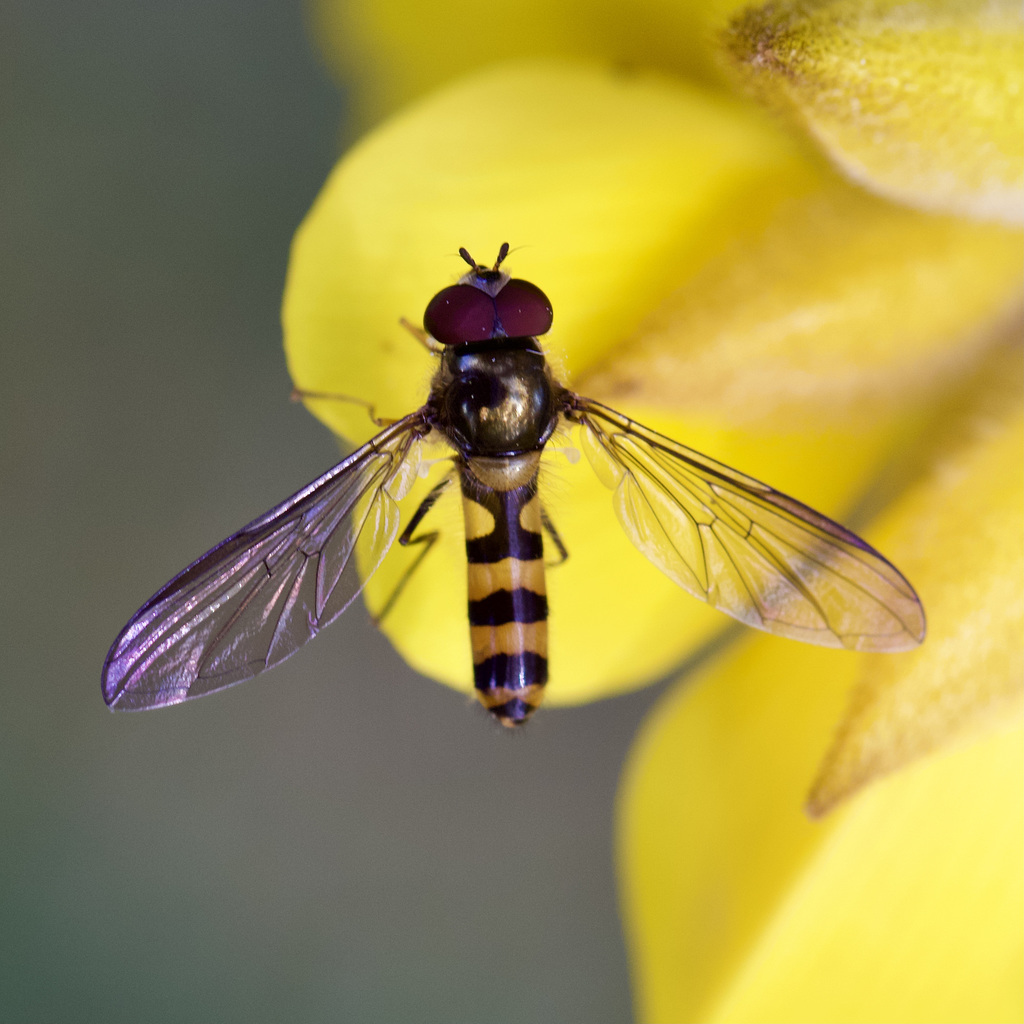
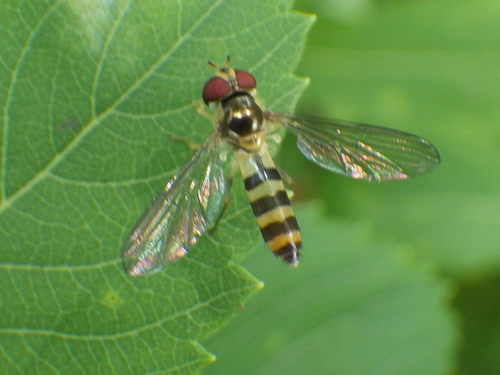
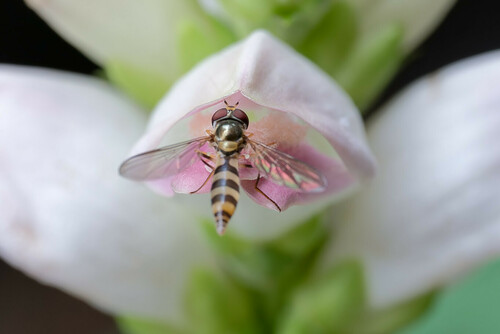
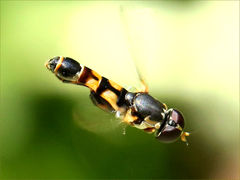
The banded thintail hoverfly is a small insect with wing length about 7 to 10 mm. It has a completely yellow face and a black lunula with an extra black spot above it. Adults are seen from April to September visiting many garden and woodland flowers, while the larvae eat aphids on shrubs and trees.
Source: Wikipedia
How to recognize it
The face is entirely yellow and the lunula is black with an additional black mark above it.
Source: Wikipedia
Size
Wing length ranges from 7 to 9.75 mm.
Source: Wikipedia
Where it lives
It lives in deciduous and coniferous forests, hedgerows, suburban gardens and parks. Adults visit a wide variety of flowers such as white umbellifers, maple, hawthorn, euphorbia, holly, privet, honeysuckle, oregano, knotweed, tormentil, blackthorn, buttercup, rhododendron, brambles, willow, elder, ragwort, goldenrod, rowan and dandelion.
Source: Wikipedia
What it eats
Larvae feed on aphids found on bushes, shrubs and trees. Adults feed on nectar from many flowers listed above.
Source: Wikipedia
Life cycle
Adults are on the wing from April through September.
Source: Wikipedia
When you see it
Flight period spans April to September.
Source: Wikipedia
Where it comes from
It is a Holarctic species, occurring across Europe into Siberia and the Russian Far East, and in North America from Alaska down to California and Colorado.
Source: Wikipedia
Lookalikes
For identification details see the male genitalia illustration by Hippa (1968) and larval description by Rotheray (1994).
Source: Wikipedia
Where it is found in the US
Recorded in 29 of 51 states and DC. Most records: Alaska, Vermont, Maine, Washington, New Hampshire, New York, California, North Carolina.
Darker = more records. Counts are museum and citizen-science records, not population size.
Source: GBIF
Status: native in North America; native in Canada. Source: iNaturalist
Months it is reported in the US
Source: GBIF
More photos
Questions people ask
When can I see banded thintail hoverflies?
They are active from early spring to early autumn, roughly April through September.
Source: Wikipedia
What do the larvae eat?
The larvae prey on aphids that live on bushes, shrubs and trees.
Source: Wikipedia
Where does this hoverfly live?
It inhabits forests, hedgerows, gardens and parks, and visits many common flowers.
Source: Wikipedia
Same family (Syrphidae)


Sources
- Wikipedia: https://en.wikipedia.org/wiki/Meliscaeva_cinctella
Look it up elsewhere: GBIF · iNaturalist · BugGuide · ITIS · Wikipedia
Text written 2026-10-22 from the sources above and checked sentence by sentence against them. Data fetched 2026-10-22.