 Bug FAQ
Australian House Centipede
Allothereua maculata · Order: Scutigeromorpha · Family: Scutigeridae
Source: Wikipedia

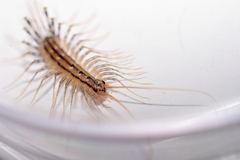
The Australian house centipede is a pale-brown centipede with dark markings that grows to about 2 cm long. It lives in damp, poorly ventilated parts of homes and in urban woodlands across southern Australia, from Western Australia to Queensland. It preys on insects and other arthropods and is generally considered harmless to humans.
Source: Wikipedia
Size
Adults reach 20 to 25 mm (about 0.8 to 1.0 in) in length.
Source: Wikipedia
Is it a pest in the house?
Its presence in homes shows it prefers damp, poorly ventilated conditions. It is generally considered harmless.
Source: Wikipedia
Does it bite or sting?
It is generally considered harmless and does not pose a bite or sting risk.
Source: Wikipedia
Where it lives
It is found in urban areas and woodland, especially in damp, poorly ventilated parts of houses.
Source: Wikipedia
What it eats
It hunts and eats insects and other arthropods. It is generally considered harmless to people.
Source: Wikipedia
Lookalikes
The name “house-centipede” is also used for other species elsewhere, but this Australian species is Allothereua maculata.
Source: Wikipedia
More photos


Questions people ask
Where are they found?
They live in damp, poorly ventilated parts of homes and in urban woodlands across southern Australia, from Western Australia to Queensland.
Source: Wikipedia
How can I identify an Australian house centipede?
Look for a pale brown body with dark markings, a pair of long antennae on the head, and similar long tail appendages.
Source: Wikipedia
Same family (Scutigeridae)


Sources
- Wikipedia: https://en.wikipedia.org/wiki/Allothereua_maculata
Look it up elsewhere: GBIF · iNaturalist · BugGuide · ITIS · Wikipedia
Text written 2026-10-23 from the sources above and checked sentence by sentence against them. Data fetched 2026-10-22.