 Bug FAQ
Asian Weaver Ant
Oecophylla smaragdina · Order: Hymenoptera · Family: Formicidae
Also called: Green Tree Ant, Green Weaver Ant, Kerengga Ant, Orange Weaver Ant
Source: Wikipedia
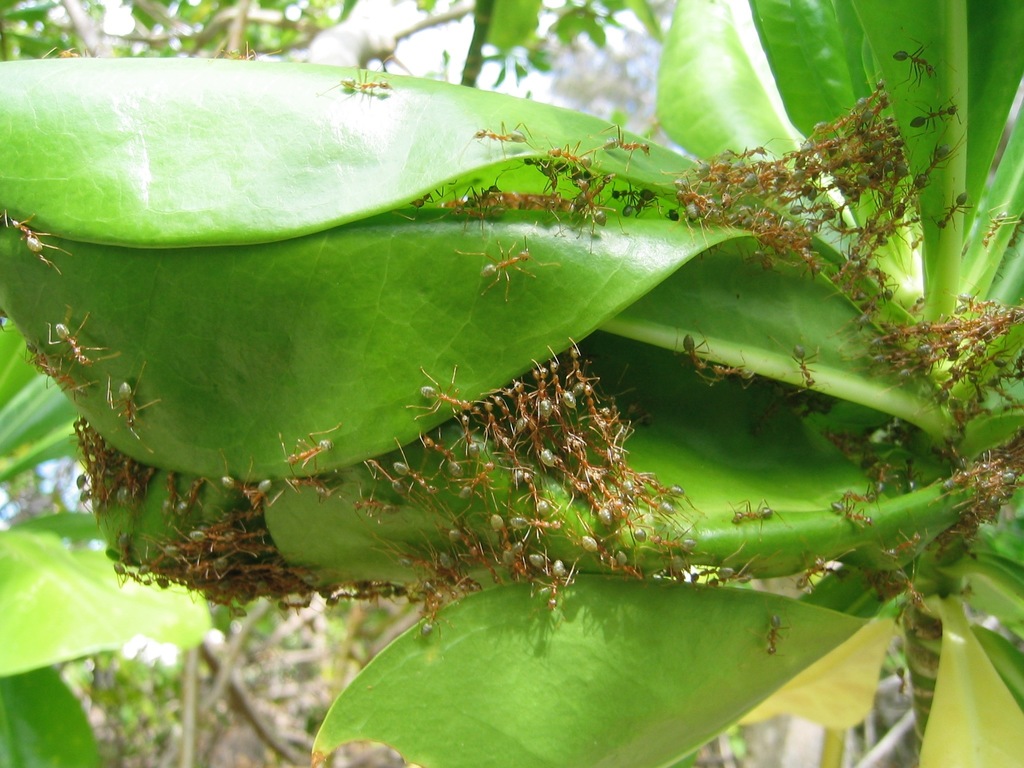
Workers are orange and 5 to 7 mm long; queens are larger, greenish-brown and 20 to 25 mm. They live in leaf nests in trees, especially in tropical Asia and Australia. They hunt insects, tend scale insects for honeydew, and are sometimes used for pest control.
Source: Wikipedia
How to recognize it
Workers and major workers are mostly orange in colour. Queens are typically greenish-brown, giving the species its emerald name.
Source: Wikipedia
Size
Worker ants measure 5 to 7 mm in length. Queens reach 20 to 25 mm long.
Source: Wikipedia
Is it a pest in the house?
They do not sting but can bite painfully and release irritating chemicals from their abdomen. In Indonesia they are found on many cultivated trees such as banana, coconut, oil palm and mango.
Source: Wikipedia
Does it bite or sting?
They do not sting; their bite can be painful and may inject irritant chemicals.
Source: Wikipedia
How to get rid of it
Ant colonies have been used for pest control since at least 304 CE in China, especially in citrus orchards.
Source: Wikipedia
Where it lives
The species is arboreal, building nests among tree foliage. In Singapore they are common on sea hibiscus and great morinda trees, which provide nectar and receive protection from herbivores.
Source: Wikipedia
What it eats
They prey on insects such as beetles, flies and other hymenopterans. They also tend aphids, scale insects and other homopterans for honeydew, especially in canopy lianas.
Source: Wikipedia
Life cycle
Each colony has a single queen whose offspring are moved to other nests in the colony. A mature colony can live about eight years.
Source: Wikipedia
When you see it
In parts of its range people use the ants as a natural pest-control method.
Source: Wikipedia
Where it comes from
Colonies have multiple leaf-stitched nests in trees, a trait reflected in the name oecophylla meaning “leaf-house”.
Source: Wikipedia
Lookalikes
Some jumping spiders mimic the ants chemically to infiltrate nests and eat their larvae.
Source: Wikipedia
More photos

Questions people ask
Do they bite?
Yes, they can bite and the bite may be painful with irritating chemicals.
Source: Wikipedia
Are they harmful to trees?
They are not known to damage trees; instead they protect host trees from herbivorous insects.
Source: Wikipedia
Can they be used for pest control?
Yes, they have been employed as natural pest control agents for centuries.
Source: Wikipedia
Same family (Formicidae)
 Eastern Black Carpenter AntCamponotus pennsylvanicusCan damage your home
 Red Imported Fire AntSolenopsis invictaCan sting
 American Winter AntPrenolepis imparis
 Argentine AntLinepithema humileNuisance, not dangerous
 Immigrant Pavement AntTetramorium immigransCan sting
 Odorous House AntTapinoma sessileCan damage your home
Sources
- Wikipedia: https://en.wikipedia.org/wiki/Oecophylla_smaragdina
Look it up elsewhere: GBIF · iNaturalist · BugGuide · ITIS · Wikipedia
Text written 2026-10-22 from the sources above and checked sentence by sentence against them. Data fetched 2026-10-22.