 Bug FAQ
Asian Marauder Ant
Carebara diversa · Order: Hymenoptera · Family: Formicidae
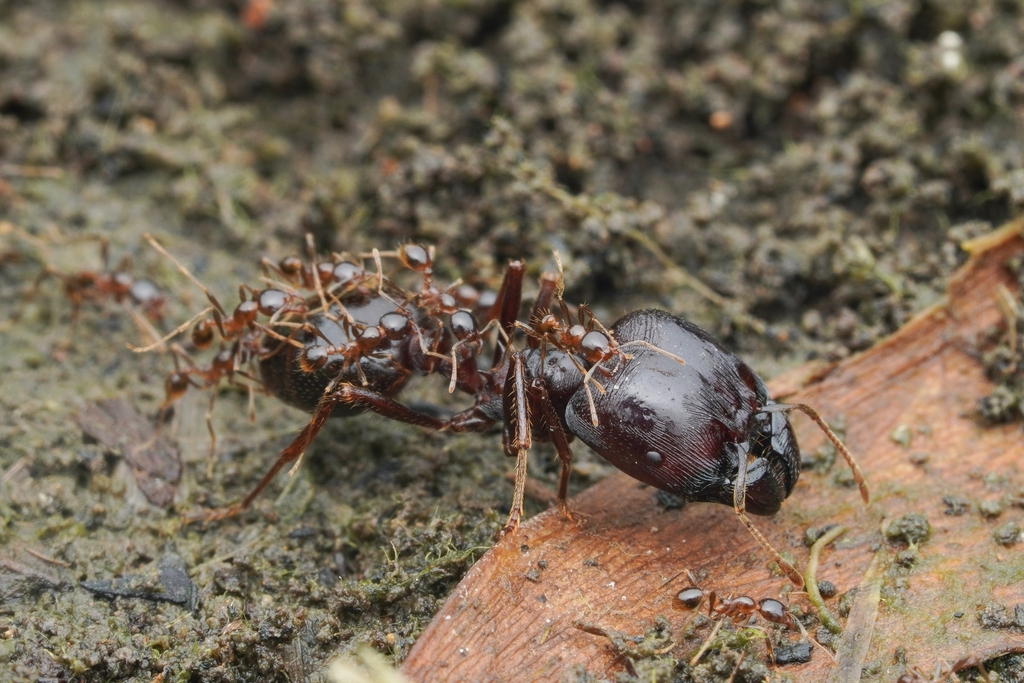
Asian Marauder Ants have tiny workers about 1.3 to 2.5 mm long and much larger majors with heads up to twelve times bigger. Colonies live in soil or under rocks, form long foraging columns and sometimes roof those trails with soil arches.
Source: Wikipedia
How to recognize it
Minor workers are yellowish-brown to reddish-brown, while majors are reddish-brown to blackish-brown.
Source: Wikipedia
Size
Minor workers measure 1.3 to 2.5 mm in length. Major workers have heads about twelve times larger than those of the smallest workers.
Source: Wikipedia
Where it lives
They build large colonies in soil or beneath rocks. Foraging ants often march in long columns and may roof the trails with arches made of soil particles.
Source: Wikipedia
What it eats
They hunt small animals such as insects and also collect nectar-like substances. In addition to insects, they eat fruits and grains.
Source: Wikipedia
Life cycle
The species performs nuptial flights. Colonies may contain many queens, up to sixteen.
Source: Wikipedia
Where it comes from
They have been introduced to Japan, likely via commercial traffic from Southeast Asia.
Source: Wikipedia
Lookalikes
Because of their raiding behavior, they are often compared to army ants, though there are important differences.
Source: Wikipedia
Questions people ask
What colors are the different workers?
Minor workers are yellowish-brown to reddish-brown, while major workers range from reddish-brown to blackish-brown.
Source: Wikipedia
What do they eat?
They prey on small insects, collect nectar-like substances, and also consume fruits and grains.
Source: Wikipedia
Same family (Formicidae)
 Eastern Black Carpenter AntCamponotus pennsylvanicusCan damage your home
 Red Imported Fire AntSolenopsis invictaCan sting
 American Winter AntPrenolepis imparis
 Argentine AntLinepithema humileNuisance, not dangerous
 Immigrant Pavement AntTetramorium immigransCan sting
 Odorous House AntTapinoma sessileCan damage your home
Sources
- Wikipedia: https://en.wikipedia.org/wiki/Carebara_diversa
Look it up elsewhere: GBIF · iNaturalist · BugGuide · Wikipedia
Text written 2026-10-23 from the sources above and checked sentence by sentence against them. Data fetched 2026-10-22.