 Bug FAQ
Aphaenogaster cockerelli
Aphaenogaster cockerelli · Order: Hymenoptera · Family: Formicidae
Source: Wikipedia
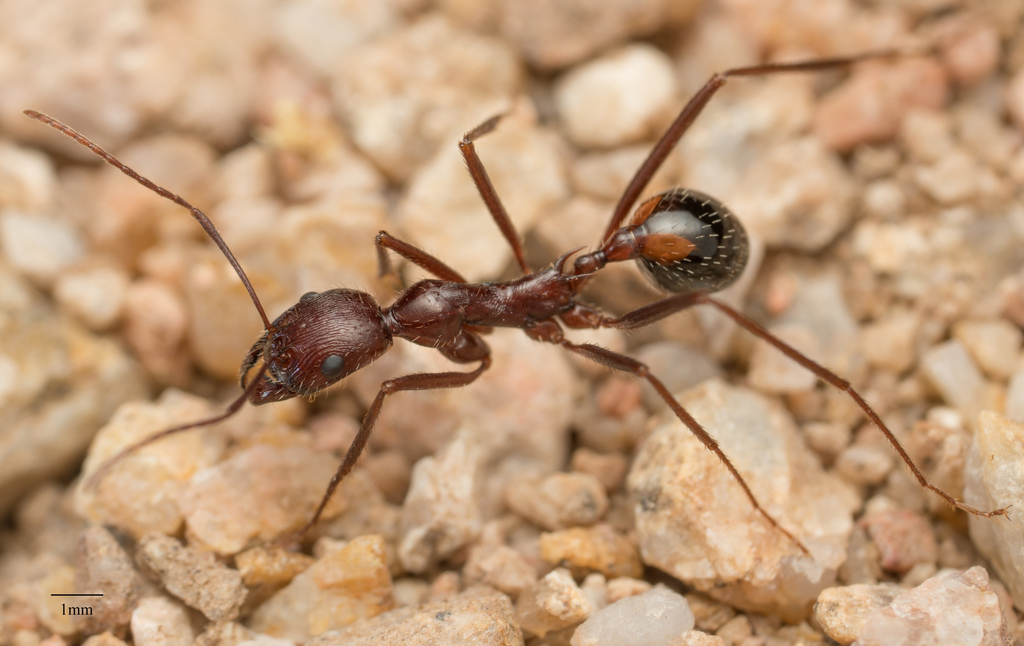
It lives in upland desert plains of the Southwestern United States and Mexico, building large underground colonies on open ground or beside rocks. Workers forage daily for seeds, plant material and dead insects, with about half of their diet consisting of insect corpses.
Source: Wikipedia
How to recognize it
Two distinctive spines on the propodeum help identify it. The shape of its head distinguishes it from similar species.
Source: Wikipedia
What it eats
Workers leave the nest each day to collect seeds, plant material and dead insects. Roughly half of what they eat are the corpses of insects.
Source: Wikipedia
Life cycle
Nuptial flights occur in July at dusk in the Chihuahuan Desert. Each colony has a single queen.
Source: Wikipedia
When you see it
Nuptial flights happen in July at dusk in the Chihuahuan Desert.
Source: Wikipedia
Lookalikes
It can be confused with Novomessor albisetosus, but differs in head shape.
Source: Wikipedia
Where it is found in the US
Recorded in 5 of 51 states and DC. Most records: Texas, Arizona, New Mexico, Nevada, California.
Darker = more records. Counts are museum and citizen-science records, not population size.
Source: GBIF
Status: native in North America; native in United States. Source: iNaturalist
Months it is reported in the US
Source: GBIF
More photos


Questions people ask
When are their nuptial flights?
Nuptial flights occur in July at dusk in the Chihuahuan Desert.
Source: Wikipedia
How can I tell them apart from similar ants?
Look for two spines on the propodeum and the distinctive shape of the head.
Source: Wikipedia
Same family (Formicidae)
 Eastern Black Carpenter AntCamponotus pennsylvanicusCan bite
 Red Imported Fire AntSolenopsis invictaCan sting
 American Winter AntPrenolepis imparis
 Argentine AntLinepithema humileNuisance, not dangerous
 Immigrant Pavement AntTetramorium immigransCan sting
 Odorous House AntTapinoma sessileCan damage your home
Sources
- Wikipedia: https://en.wikipedia.org/wiki/Novomessor_cockerelli
Look it up elsewhere: GBIF · iNaturalist · BugGuide · ITIS · Wikipedia
Text written 2026-10-25 from the sources above and checked sentence by sentence against them. Data fetched 2026-10-25.