 Bug FAQ
Agrarian Sac Spider
Cheiracanthium inclusum · Order: Araneae · Family: Cheiracanthiidae
Also called: American Yellow Sac Spider, Yellow Sac Spider
Source: Wikipedia, digitalcommons.usu.edu

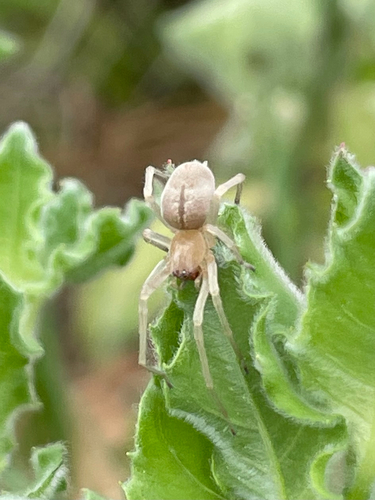
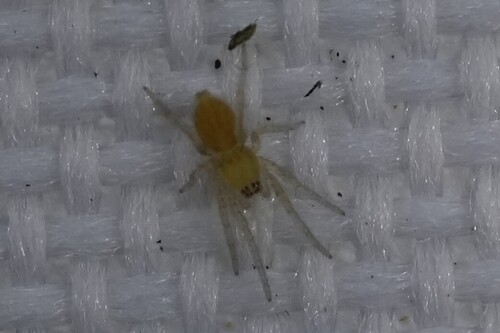
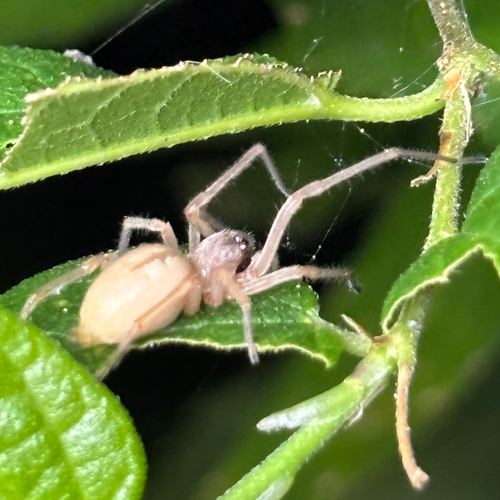
The yellow sac spider is a small pale-yellow spider with dark brown markings and an orange-brown stripe on its abdomen. Females are 5 to 9 mm long, males 4 to 8 mm, and the leg span can reach about 2.5 cm, the front legs being the longest. It lives in forest foliage, gardens, trees, shrubs and can also enter homes, where it may bite humans causing moderate pain and itching for up to ten days.
Source: Wikipedia
How to recognize it
It is pale yellow-beige with dark brown marks on its jaws, palps and the ends of its feet. An orange-brown stripe often runs down the middle of its abdomen.
Source: Wikipedia
Size
Females measure 5 to 9 mm in body length, males 4 to 8 mm.
Source: Wikipedia
Is it a pest in the house?
Many Utah residents know the hobo spider but may not realize the yellow sac spider also enters homes.
Source: digitalcommons.usu.edu
Does it bite or sting?
The spider is venomous and can bite humans. A bite starts with moderate pain and itching, and symptoms normally resolve in 7 to 10 days.
Source: Wikipedia
How to get rid of it
Many Utah residents are unaware that this spider’s bite is less toxic than that of the hobo spider.
Source: digitalcommons.usu.edu
Where it lives
It is commonly found in forest foliage, gardens, trees and shrubs. It also takes shelter in houses and other human structures.
Source: Wikipedia
What it eats
It does not spin webs; it actively hunts insects and other spiders. It detects prey mainly by feeling vibrations, not by sight.
Source: Wikipedia
Life cycle
Females mate once and lay their first egg mass about two weeks after mating. The mother stays with the eggs and juveniles for roughly 17 days until they molt.
Source: Wikipedia
When you see it
Eggs are laid mainly in June and July. Adults or sub-adults usually overwinter.
Source: Wikipedia
Where it comes from
It is native to the Americas, including North, Central and South America and the West Indies.
Source: Wikipedia
Lookalikes
It is closely related to the European yellow sac spider, Cheiracanthium mildei, which looks similar and also lives in North American homes.
Source: Wikipedia
Where it is found in the US
Recorded in 29 of 51 states and DC. Most records: California, Texas, New Mexico, Indiana, Colorado, Florida, North Dakota, Ohio.
Darker = more records. Counts are museum and citizen-science records, not population size.
Source: GBIF
Status: native in North America; native in Canada; native in United States. Source: iNaturalist
Months it is reported in the US
Source: GBIF
More photos

Questions people ask
Do yellow sac spiders bite people?
Yes, they can bite, causing moderate pain and itching that usually clears within a week.
Source: Wikipedia
Where are yellow sac spiders found?
They live in forest foliage, gardens, trees, shrubs and often enter homes.
Source: Wikipedia
What do yellow sac spiders eat?
They actively hunt insects and other spiders without using webs.
Source: Wikipedia
When do they lay eggs?
Eggs are laid mainly in June and July, and the mother guards them for about 17 days.
Source: Wikipedia
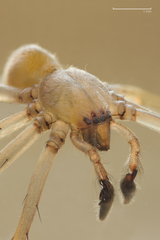
Same family (Cheiracanthiidae)
Sources
- Wikipedia: https://en.wikipedia.org/wiki/Cheiracanthium_inclusum
- digitalcommons.usu.edu: https://digitalcommons.usu.edu/extension_curall/992
Look it up elsewhere: GBIF · iNaturalist · BugGuide · ITIS · Wikipedia
Text written 2026-10-23 from the sources above and checked sentence by sentence against them. Data fetched 2026-10-23.