 Bug FAQ
African Big-headed Ant
Pheidole megacephala · Order: Hymenoptera · Family: Formicidae
Also called: Bigheaded ant, Coastal Brown Ant, big- headed ant
Source: UF/IFAS

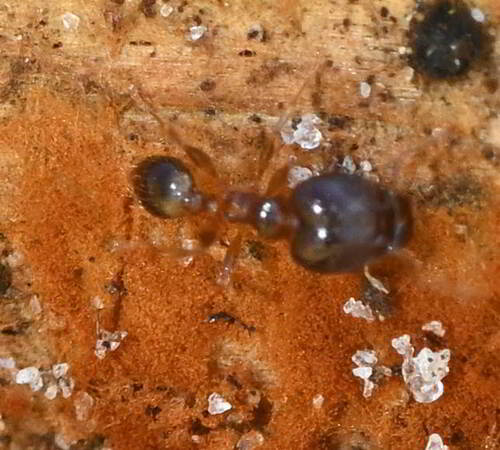
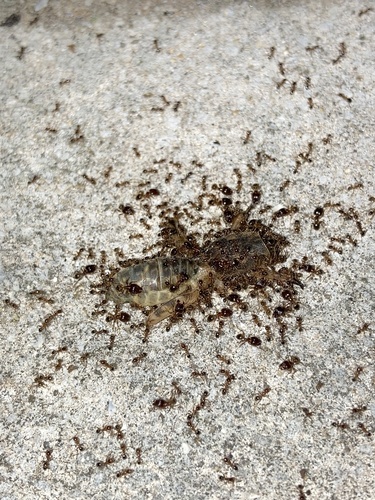
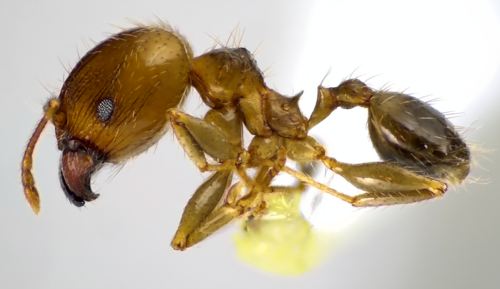
Big-headed ants have two worker types: small reddish-brown minors about 2 mm long and larger majors up to 4 mm with a very big, partly sculptured head. They nest underground, can move indoors, and are known for creating loose soil piles and fragile foraging tubes that can be mistaken for termite tubes.
Size
Minor workers are about 2 mm long, while major workers are 3 to 4 mm, roughly twice the length of minors.
Is it a pest in the house?
Inside homes they are a nuisance, forming soil piles and foraging tubes on walkways, and they may chew on irrigation, telephone, and electrical cables.
Does it bite or sting?
They do not sting and will only bite if the nest is disturbed; the bite is not painful.
Source: UF/IFAS
How to get rid of it
Control is hard because colonies are numerous and often spread across property lines.
Source: UF/IFAS
Where it lives
Colonies are built underground but the ants can also establish nests inside homes.
Source: Wikipedia
What it eats
They feed on dead insects, small invertebrates, honeydew from aphids and other sap-sucking insects, and they prey on moth eggs such as those of the African sugarcane borer.
Source: Wikipedia
Life cycle
A queen can lay up to about 290 eggs each month, and the eggs hatch in two to four weeks.
Source: Wikipedia
When you see it
In Florida, winged ants take their nuptial flights during winter and spring.
Source: Wikipedia
Where it comes from
Originally from Africa, they have spread to many tropical and subtropical regions worldwide.
Source: Wikipedia
Lookalikes
Their soil-covered foraging tubes can be confused with the tubes of subterranean termites, though the ant tubes are more fragile.
Where it is found in the US
Recorded in 9 of 51 states and DC. Most records: Florida, Hawaii, California, Maryland, Illinois, Wisconsin, Louisiana, District of Columbia.
Darker = more records. Counts are museum and citizen-science records, not population size.
Source: GBIF
Status: introduced in North America; introduced in Canada. Source: iNaturalist
Months it is reported in the US
Source: GBIF
More photos

Questions people ask
How can I tell big-headed ants from termites?
Ant foraging tubes are fragile and covered with loose soil, whereas termite tubes are sturdier.
Source: UF/IFAS
Can they damage my home’s wiring?
Yes, they are known to chew on irrigation, telephone, and electrical cables.
Source: Wikipedia
Same family (Formicidae)
 Eastern Black Carpenter AntCamponotus pennsylvanicusCan damage your home
 Red Imported Fire AntSolenopsis invictaCan sting
 American Winter AntPrenolepis imparis
 Argentine AntLinepithema humileNuisance, not dangerous
 Immigrant Pavement AntTetramorium immigransCan sting
 Odorous House AntTapinoma sessileCan damage your home
Sources
- UF/IFAS: https://edis.ifas.ufl.edu/publication/IN712
- Wikipedia: https://en.wikipedia.org/wiki/Pheidole_megacephala
Look it up elsewhere: GBIF · iNaturalist · BugGuide · ITIS · Wikipedia
Text written 2026-10-23 from the sources above and checked sentence by sentence against them. Data fetched 2026-10-22.