 Bug FAQ
Brown recluse vs black widow: how to tell them apart
Side by side. Every line is quoted from each bug's page and its sources.
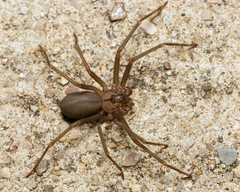
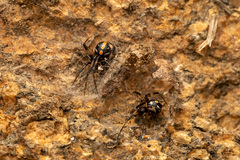
Is it dangerous?
Brown Recluse
Most bites are minor, but a small number cause the skin around the bite to die. Less than 1 percent cause illness through the body, such as anemia or kidney injury.
Source: Wikipedia, Penn State Extension
Southern Black Widow
Southern black widow females can bite people, causing pain but rarely fatal effects.
Source: Wikipedia, UF/IFAS, Penn State Extension
How to recognize it
Brown Recluse
They have a dark violin-shaped marking on the cephalothorax with the neck pointing toward the rear. The abdomen and legs are uniformly colored without stripes or mottling.
Southern Black Widow
Female Southern black widows are glossy black with a red hourglass on the belly’s underside.
Source: Wikipedia, UF/IFAS, Penn State Extension
Size
Does it bite or sting?
Brown Recluse
Their venom contains sphingomyelinase D, which can destroy tissue around the bite. Most bites are minor, but about 37 % cause skin necrosis and 14 % cause systemic illness; less than 1 % lead to severe symptoms like hemolytic anemia or kidney injury.
Source: Wikipedia, Penn State Extension
Southern Black Widow
Only mature females have fangs large enough to bite humans, and their chelicerae are about 1 mm long. The bite is usually painful but rarely fatal to healthy people. Bites are most likely when a female is protecting an egg sac.
Source: Wikipedia, Penn State Extension, UF/IFAS
Is it a pest in the house?
Brown Recluse
They are established in sixteen states, including Alabama, Texas, and Ohio, and often hide in stored clothes, shoes, and other items.
Source: Penn State Extension
Southern Black Widow
Their three-dimensional cobwebs are strong and can be found in garages, barns and other dark corners of homes. Females guard their egg sacs in summer, which is when most bites to humans occur. They can help control pest insects such as fire ants and harvester ants.
Source: Wikipedia, Penn State Extension, UF/IFAS
Where it lives
Brown Recluse
They hide in cracks, under stored items, and in clothing, shoes, or bedding, biting only when pressed against skin.
Source: Wikipedia, Penn State Extension
Southern Black Widow
They are commonly found in undisturbed places such as under stones, in woodpiles, vacant rodent holes, barns, garages, and outdoor privies.
Source: Penn State Extension
Full pages: Brown Recluse · Southern Black Widow · More comparisons · Questions