 Bug FAQ
Woodlouse Spider
Dysdera crocata · Order: Araneae · Family: Dysderidae
Also called: Long-fanged Six-eyed Spider, Slater Spider, Sowbug Spider, Woodhouse Spider
Source: Wikipedia, Penn State Extension
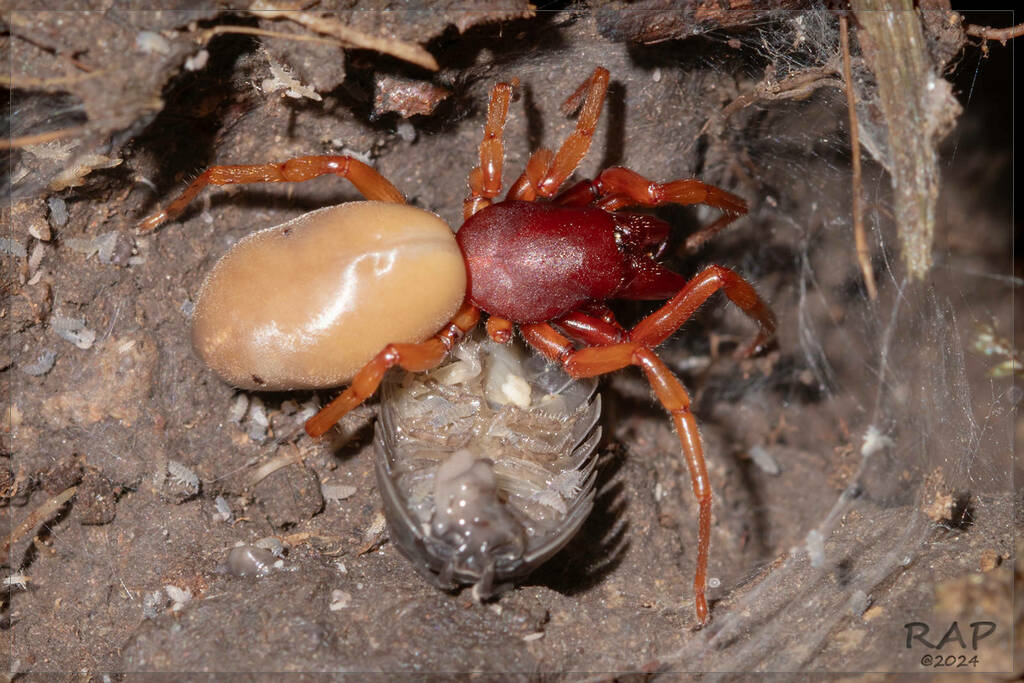
Woodlouse spiders are small reddish-orange spiders with a pale abdomen and very large chelicerae; females are 11 to 15 mm long and males 9 to 10 mm. They live under logs, rocks, bricks, plant pots and leaf litter in warm places and are also found inside houses, especially near woodlice. Their main prey are woodlice, though they will also take other small invertebrates, and they hunt at night without using a web.
Source: Wikipedia
How to recognize it
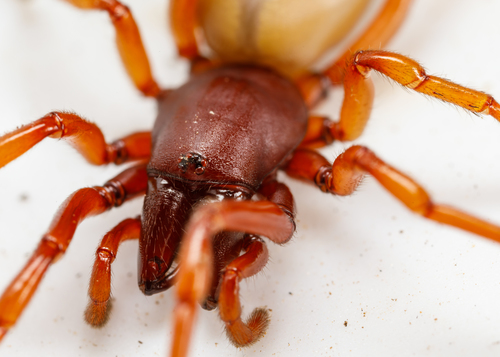
Their chelicerae are unusually large for a spider of this size.
Source: Wikipedia
Size
Adult females measure 11 to 15 mm in body length, while males are 9 to 10 mm long.
Source: Wikipedia, Penn State Extension
Is it a pest in the house?
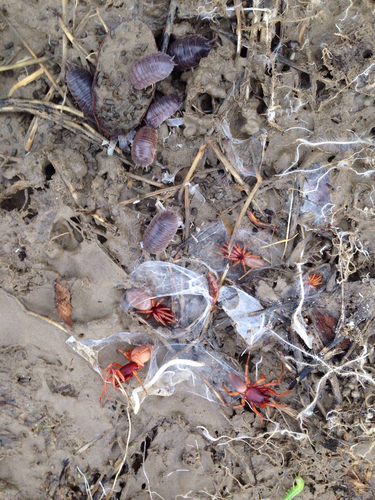
They are the only Dysdera species known in North America and are sometimes found inside homes. They are called woodlouse hunters because they prey on pill bugs and sow bugs. They also feed on other arthropods.
Source: Wikipedia, Penn State Extension
Does it bite or sting?
If handled they may bite, but bites have not caused serious medical problems. Bite sites can become itchy and show a small red patch about 4 to 5 mm across. The bites do not produce systemic neurotoxic or cytotoxic effects.
Source: Wikipedia, Penn State Extension
How to get rid of it
Adults probably overwinter in their adult form. Mating occurs in April and eggs are laid shortly after.
Source: Penn State Extension
Where it lives
They have also been recorded inside houses.
Source: Wikipedia
What it eats
Woodlice are their principal food, but they will also capture other small invertebrates when available.
Source: Wikipedia
Life cycle
The female lays a silken egg sac that can hold up to 70 eggs and likely cares for the young after they hatch.
Source: Wikipedia
Where it comes from
Originally from the Mediterranean, they now have a worldwide distribution.
Source: Wikipedia
Lookalikes
They can be confused with the rarer Dysdera erythrina, which is not usually found near human dwellings.
Source: Wikipedia
Where it is found in the US
Recorded in 46 of 51 states and DC. Most records: California, Colorado, New York, Pennsylvania, Ohio, Massachusetts, Utah, Illinois.
Darker = more records. Counts are museum and citizen-science records, not population size.
Source: GBIF
Status: introduced in North America; introduced in United States; introduced in Canada. Source: iNaturalist
Months it is reported in the US
Source: GBIF
More photos


Questions people ask
Do woodlouse spiders bite people?
Yes, they can bite if handled, but the bite only causes a small, very itchy spot.
Source: Wikipedia, Penn State Extension
Where might I find a woodlouse spider in my home?
They may be found under logs, rocks, bricks, plant pots, leaf litter, or in corners of houses, especially near woodlice.
Source: Wikipedia
What do woodlouse spiders eat?
Their main prey are woodlice, though they will also catch other small invertebrates.
Source: Wikipedia
Sources
- Wikipedia: https://en.wikipedia.org/wiki/Woodlouse_spider
- Penn State Extension: https://extension.psu.edu/woodlouse-hunter-spider
Look it up elsewhere: GBIF · iNaturalist · BugGuide · ITIS · Wikipedia
Text written 2026-10-23 from the sources above and checked sentence by sentence against them. Data fetched 2026-10-23.