 Bug FAQ
Western Forest Scorpion
Uroctonus mordax · Order: Scorpiones · Family: Chactidae
Also called: California Forest Scorpion, Northwest Forest Scorpion
Source: Wikipedia

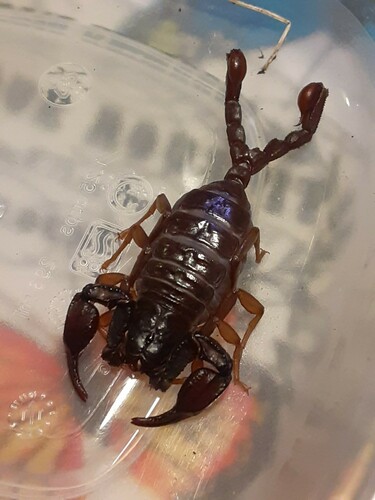
These scorpions are small, dark brown or black, and have a squat body with a thin tail. They live in moist forest habitats under rocks, bark, and dead wood, mainly in California’s redwood and oak woodlands and the Bay Area, extending into Oregon and southern Washington. They are very shy, hunt only on moonless nights, and their sting is weaker than a honeybee’s.
Source: Wikipedia
How to recognize it
The fifth segment of the tail has a ventral ridge that splits into a Y-shape.
Source: Wikipedia
Size
Adults are dark brown or black, and males are smaller and shorter than females.
Source: Wikipedia
Where it lives
They prefer moist, shaded forest floors, hiding under rocks, logs, bark, or dead trees on south- or west-facing slopes.
Source: Wikipedia
Life cycle
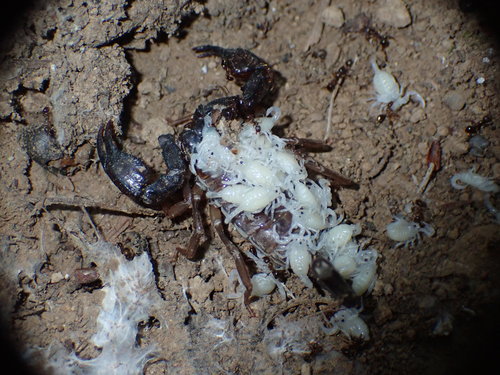
Females give birth to young at an early developmental stage, mainly during the summer months.
Source: Wikipedia
When you see it
They are active on moonless nights and give birth primarily in summer.
Source: Wikipedia
Where it comes from
Their range is almost entirely within California’s redwood forests and oak woodlands, especially the San Francisco Bay Area, with extensions into western Oregon and southern Washington.
Source: Wikipedia
Where it is found in the US
Recorded in 4 of 51 states and DC. Most records: California, Oregon, Washington, Kansas.
Darker = more records. Counts are museum and citizen-science records, not population size.
Source: GBIF
Status: endemic in United States; native in North America. Source: iNaturalist
Months it is reported in the US
Source: GBIF
More photos


Questions people ask
Where might I find a western forest scorpion in my yard?
Look under rocks, logs, bark, or dead wood in moist, shaded areas, especially on south- or west-facing slopes.
Source: Wikipedia
Sources
- Wikipedia: https://en.wikipedia.org/wiki/Uroctonus_mordax
Look it up elsewhere: GBIF · iNaturalist · BugGuide · Wikipedia
Text written 2026-10-22 from the sources above and checked sentence by sentence against them. Data fetched 2026-10-22.