 Bug FAQ
Twospotted Spider Mite
Tetranychus urticae · Order: Trombidiformes · Family: Tetranychidae
Also called: Carmine spider mite, Common spider mite, Two-spotted spider mite, red spider mite
Source: Wikipedia, Penn State Extension, umass.edu

Adult females are tiny (about 0.4 mm) and show two dark spots on each side of their bodies. They feed on many vegetables, fruits, ornamental plants and trees, piercing leaf cells and removing their contents. Control can include predatory mites, proper weed management, and rotating miticide classes to avoid resistance.
Source: Penn State Extension, udel.edu, umass.edu, Wikipedia
How to recognize it
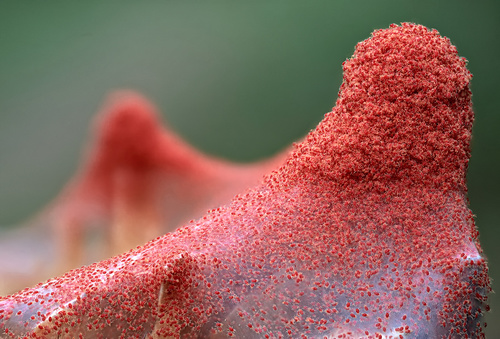
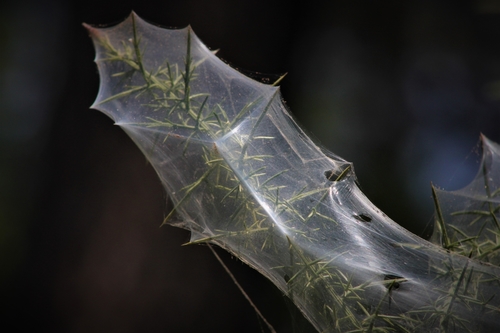
Adults have two large dark spots on the sides of a transparent body, and females may spin a fine web on leaves. They have a cephalothorax and abdomen, four pairs of legs, red ocelli, and no antennae.
Source: Penn State Extension, udel.edu, umass.edu, Wikipedia
Size
Adult females are about 0.4 mm long, barely visible to the naked eye.
Source: Wikipedia, Penn State Extension
Is it a pest in the house?
Mites damage leaves by sucking cell contents, leaving tiny pale spots that can progress to yellowing, stippling and loss of buds or flowers. They attack shade trees, shrubs and flowers as well as garden vegetables.
Source: Wikipedia, umass.edu, Penn State Extension
Does it bite or sting?
They have piercing-sucking mouthparts used to feed on plant cells, not on people or pets.
Source: udel.edu
How to get rid of it
Predatory mite Phytoseiulus persimilis is a common biological control agent. Registered miticides can be applied according to label directions on infested ornamentals. Rotate miticide classes after every third application to prevent resistance. Good weed management and regular scouting help prevent outbreaks.
Source: Wikipedia, Penn State Extension, udel.edu, umass.edu
Where it lives
It is the best-known member of the spider-mite family and occurs worldwide in many agricultural settings.
Source: Wikipedia
What it eats
It feeds on hundreds of plant species, including most vegetables, fruit crops and ornamental plants. Mites pierce individual leaf cells with a stylet-like mouthpart and remove the cell contents, damaging mesophyll and chloroplasts.
Source: Wikipedia
Life cycle
Females lay translucent pearl-like eggs that hatch into larvae, then pass through a protonymph and a deutonymph stage. Reproduction is arrhenotokous: unfertilized eggs develop into males.
Source: Wikipedia
When you see it
Adults are usually pale green, but later generations can turn red.
Source: Wikipedia
Where it comes from
Originally it was native only to Eurasia.
Source: Wikipedia
Lookalikes
Other common names include red spider mite and glasshouse spider mite. Eggs are clear and spherical; larvae look like smaller adults but have only three pairs of legs. Predatory mites such as Phytoseiulus persimilis are larger, bright red and pear-shaped, not to be confused with TSSM.
Source: Penn State Extension, udel.edu, umass.edu
Where it is found in the US
Recorded in 35 of 51 states and DC. Most records: California, Ohio, Arizona, Georgia, Florida, Hawaii, Texas, Utah.
Darker = more records. Counts are museum and citizen-science records, not population size.
Source: GBIF
Status: introduced in North America; introduced in United States. Source: iNaturalist
Months it is reported in the US
Source: GBIF
More photos


Questions people ask
How can I identify a twospotted spider mite?
Look for tiny (≈0.4 mm) mites with two dark spots on each side of a translucent body; females may spin a fine web on leaf surfaces.
Source: Penn State Extension, udel.edu, Wikipedia
What plants does this mite attack?
It feeds on a wide range of vegetables, fruits, ornamental plants and shade trees, causing leaf stippling and yellowing.
Source: Wikipedia, Penn State Extension, umass.edu
How do I control a twospotted spider mite infestation?
Use predatory mites like Phytoseiulus persimilis, apply appropriate miticides and rotate chemical classes, and keep weeds and debris cleared.
Source: Wikipedia, Penn State Extension, udel.edu
Same family (Tetranychidae)
Sources
- Wikipedia: https://en.wikipedia.org/wiki/Tetranychus_urticae
- Penn State Extension: https://extension.psu.edu/twospotted-spider-mite
- umass.edu: https://www.umass.edu/agriculture-food-environment/greenhouse-floriculture/fact-sheets/twospotted-spider-mites
- udel.edu: https://www.udel.edu/academics/colleges/canr/cooperative-extension/fact-sheets/two-spotted-spider-mites/
Look it up elsewhere: GBIF · iNaturalist · BugGuide · Wikipedia
Text written 2026-10-23 from the sources above and checked sentence by sentence against them. Data fetched 2026-10-23.