 Bug FAQ
Twenty-plume Moth
Alucita hexadactyla · Order: Lepidoptera · Family: Alucitidae
Also called: Many-plumed Moth, Twenty-plumed Moth
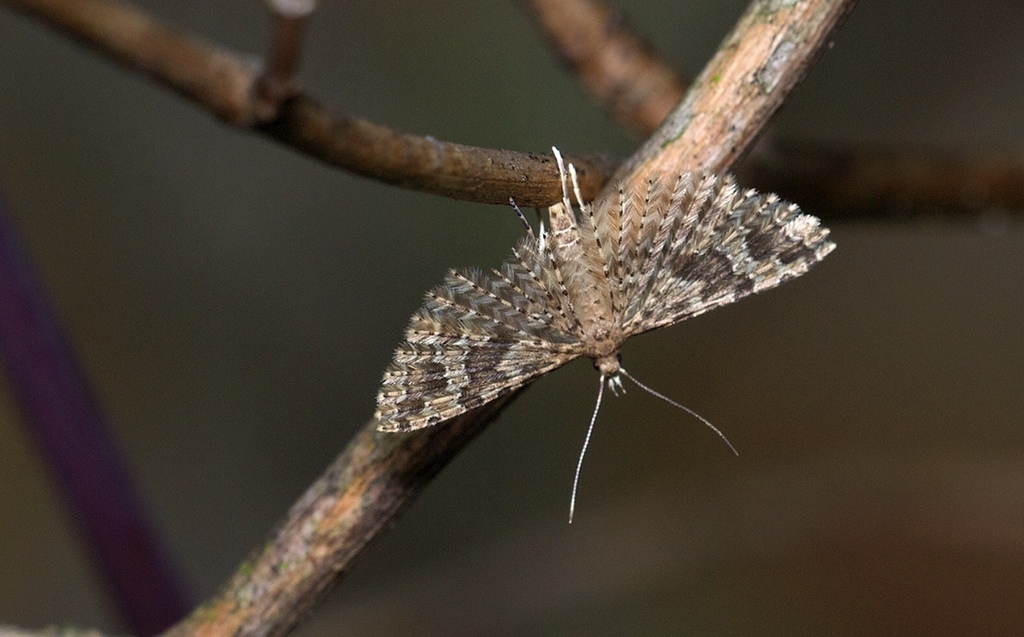
The adult has a wingspan of about 14 to 16 mm and shows a striking zig-zag pattern of white, black and brown on its wings, plus shiny backward-pointing hairs on each plume. It is common in Eurasian gardens, where it is often missed because of its small size, and it can appear any time of year as a single-brooded species. Its larvae feed inside honeysuckle flower buds and leaves, tunnelling as they eat.
Source: Wikipedia
How to recognize it
The wings display a bold zig-zag of white, black and brown, and each plume ends in shiny hairs that point backward.
Source: Wikipedia
Size
The moth’s wingspan ranges from 14 to 16 mm.
Source: Wikipedia
Where it lives
It is frequently found in gardens across its range.
Source: Wikipedia
What it eats
Larvae tunnel into and feed on honeysuckle (Lonicera) flower buds and leaves.
Source: Wikipedia
Life cycle
It has one generation per year and can be seen at any time of the year.
Source: Wikipedia
When you see it
Adults may be encountered throughout the year.
Source: Wikipedia
Where it comes from
It occurs throughout Eurasia.
Source: Wikipedia
Lookalikes
North American specimens once thought to be this species are actually a different moth.
Source: Wikipedia
Where it is found in the US
Recorded in 4 of 51 states and DC. Most records: Colorado, California, Montana, Wisconsin.
Darker = more records. Counts are museum and citizen-science records, not population size.
Source: GBIF
Months it is reported in the US
Source: GBIF
Questions people ask
What do the larvae of the twenty-plume moth eat?
They feed on honeysuckle by tunnelling inside its flower buds and leaves.
Source: Wikipedia
Where can I find this moth?
It is common in gardens throughout Eurasia, though its small size makes it easy to overlook.
Source: Wikipedia
Sources
- Wikipedia: https://en.wikipedia.org/wiki/Alucita_hexadactyla
Look it up elsewhere: GBIF · iNaturalist · BugGuide · Wikipedia
Text written 2026-10-22 from the sources above and checked sentence by sentence against them. Data fetched 2026-10-22.