 Bug FAQ
Tropidothorax leucopterus
Tropidothorax leucopterus · Order: Hemiptera · Family: Lygaeidae

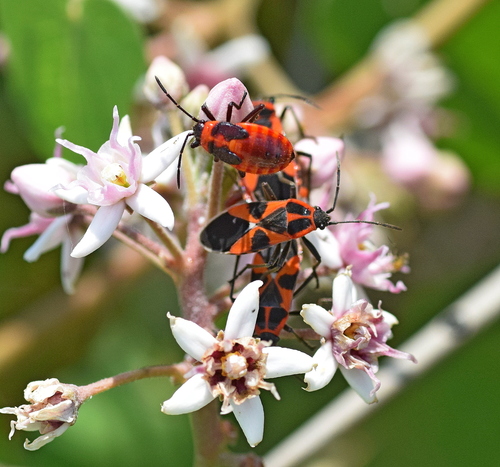
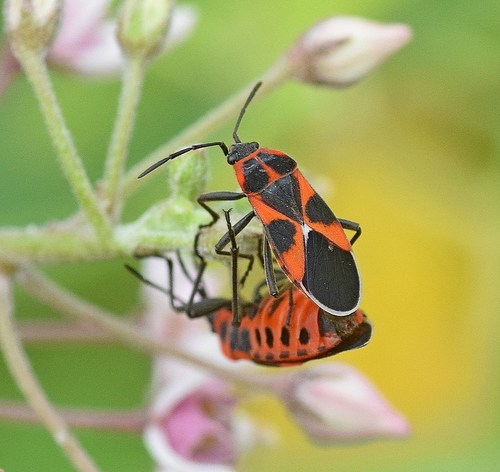
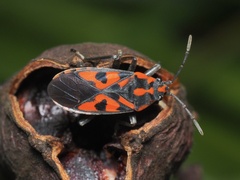
Tropidothorax leucopterus is a small true bug about 9 to 10 mm long, with an oval-elongated body in striking red and black warning colors. Its head is black with a tiny red spot, the pronotum has black margins and a front red stripe, while the wings show a red corium and a black-matt membrane with a white spot. It feeds mainly on white swallow-wort and broadleaf milkweed, storing plant toxins that make it poisonous and cause birds to avoid it.
Source: Wikipedia
How to recognize it
The bug’s body is oval-elongated and brightly colored in red and black, with a black head bearing a small red spot. The connexivum shows alternating black and red spots, the abdomen is red with black spots, and both antennae and legs are black.
Source: Wikipedia
Size
Adults reach a length of about 9 to 10 mm (0.35 to 0.39 in).
Source: Wikipedia
Where it lives
They are found on their host plants white swallow-wort and broadleaf milkweed.
Source: Wikipedia
Life cycle
Their red-black coloration warns predators because they store toxins from their poisonous host plants. Birds learn to avoid them after encountering the warning colors.
Source: Wikipedia
Where it comes from
In Europe it is recorded from many countries including France, Germany, Italy, Spain and others.
Source: Wikipedia
More photos
Questions people ask
What does Tropidothorax leucopterus look like?
It is a small, 9 to 10 mm bug with an oval body in bright red and black, a black head with a tiny red spot, and wings that are mostly red with a matte black membrane.
Source: Wikipedia
Is this bug poisonous?
Yes, it stores toxins from its host plants, making it poisonous and causing birds to avoid it.
Source: Wikipedia
Same family (Lygaeidae)


Sources
- Wikipedia: https://en.wikipedia.org/wiki/Tropidothorax_leucopterus
Look it up elsewhere: GBIF · iNaturalist · BugGuide · Wikipedia
Text written 2026-10-23 from the sources above and checked sentence by sentence against them. Data fetched 2026-10-22.