 Bug FAQ
Tawny Nesocolletes
Leioproctus fulvescens · Order: Hymenoptera · Family: Colletidae
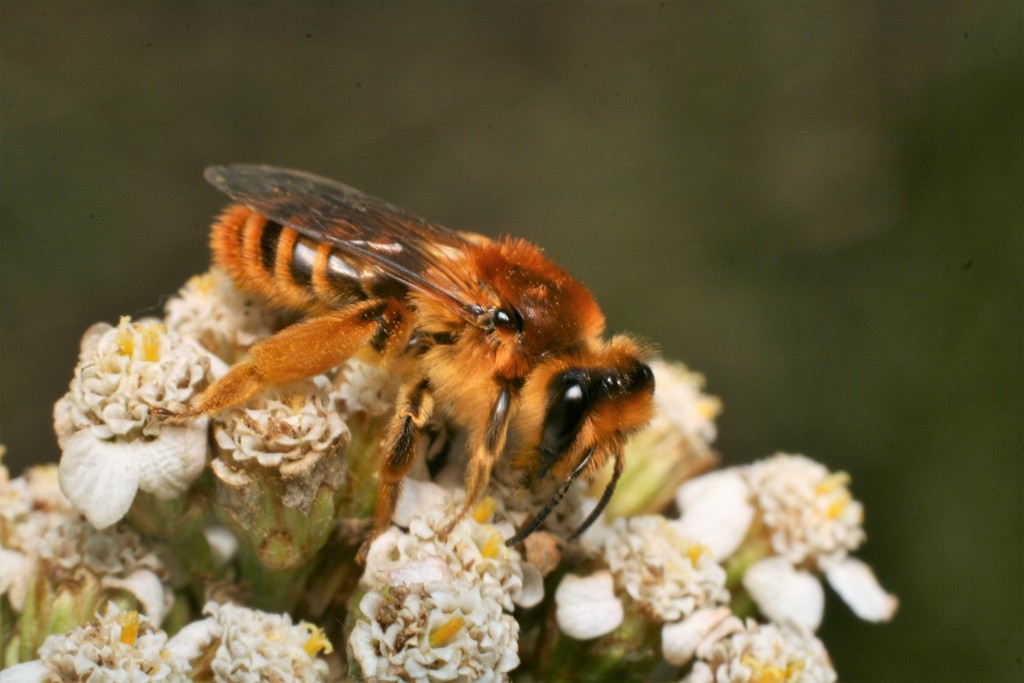
Tawny Nesocolletes are about 10 mm long and covered densely in hair. They are yellow to orange-brown, which sets them apart from other New Zealand Leioproctus that have white or cream hairs. The species is endemic to New Zealand’s South Island and flies mainly from November to March, sometimes as early as September.
Source: Wikipedia
Size
Adults measure roughly 10 mm (0.39 in) in length and are densely hairy.
Source: Wikipedia
What it eats
Females visit flowers for pollen and nectar, gathering pollen on a scopa on their hind tibia and can travel up to 2 km from their nest if needed.
Source: Wikipedia
Life cycle
Each nest chamber is stocked with a ball of pollen and nectar, an egg is laid on it, and the chamber is sealed with packed earth.
Source: Wikipedia
When you see it
Adults are most common in spring and summer, especially between November and March, though some are seen as early as September.
Source: Wikipedia
Lookalikes
Its yellow-orange hair makes it easy to tell apart from other New Zealand Leioproctus species that have lighter hairs.
Source: Wikipedia
Questions people ask
How big are Tawny Nesocolletes?
They are about 10 mm long and densely covered in hair.
Source: Wikipedia
What do they look like?
They have yellow to orange-brown hair, unlike other New Zealand Leioproctus which have white or cream hairs.
Source: Wikipedia
When are they active?
Adults fly mainly from November to March, with some sightings as early as September.
Source: Wikipedia
Same family (Colletidae)



Sources
- Wikipedia: https://en.wikipedia.org/wiki/Leioproctus_fulvescens
Look it up elsewhere: GBIF · iNaturalist · BugGuide · ITIS · Wikipedia
Text written 2026-10-23 from the sources above and checked sentence by sentence against them. Data fetched 2026-10-23.