 Bug FAQ
Surf Sandmole
Chiridotea coeca · Order: Isopoda · Family: Chaetiliidae
Also called: Mole Beach Flea, sand isopod
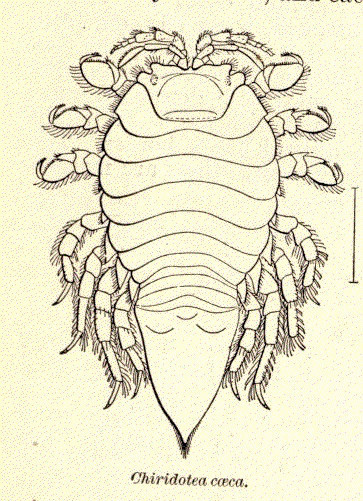
Adult surf sandmoles are about 15 mm long and 7 mm wide, with a flattened body, a round thorax, robust setae-covered legs, and a short pointed abdomen. They dig tunnels in sand with their last pair of legs and feed on carrion, holding pieces with gnathopods while chewing with mandibles.
Source: Wikipedia
How to recognize it
The body is horizontally flattened, the thorax appears almost round from above, the legs are long, robust and bear large setae, and the abdomen is short and pointed.
Source: Wikipedia
Size
Adults grow to about 15 mm in length and 7 mm in width.
Source: Wikipedia
What it eats
They feed on carrion, holding it with gnathopods while chewing pieces off with mandibles.
Source: Wikipedia
Where it is found in the US
Recorded in 10 of 51 states and DC. Most records: Georgia, Massachusetts, Connecticut, Maine, Virginia, New Jersey, Alabama, North Carolina.
Darker = more records. Counts are museum and citizen-science records, not population size.
Source: GBIF
Status: native in North America; native in United States; native in Canada. Source: iNaturalist
Months it is reported in the US
Source: GBIF
Questions people ask
What do surf sandmoles look like?
They are horizontally flattened with a round thorax, long robust legs covered in large setae, and a short pointed abdomen.
Source: Wikipedia
Where do surf sandmoles live?
They dig tunnels in sand using their last pair of legs.
Source: Wikipedia
What do surf sandmoles eat?
They feed on dead animal matter, holding it with gnathopods while chewing with their mandibles.
Source: Wikipedia
Sources
- Wikipedia: https://en.wikipedia.org/wiki/Chiridotea_coeca
Look it up elsewhere: GBIF · iNaturalist · BugGuide · ITIS · Wikipedia
Text written 2026-10-29 from the sources above and checked sentence by sentence against them. Data fetched 2026-10-29.