 Bug FAQ
Southern Two-striped Walkingstick
Anisomorpha buprestoides · Order: Phasmida · Family: Pseudophasmatidae
Also called: Two-Striped Walkingstick, Devil Rider, Florida Stick Insect, Musk Mare
Source: Wikipedia
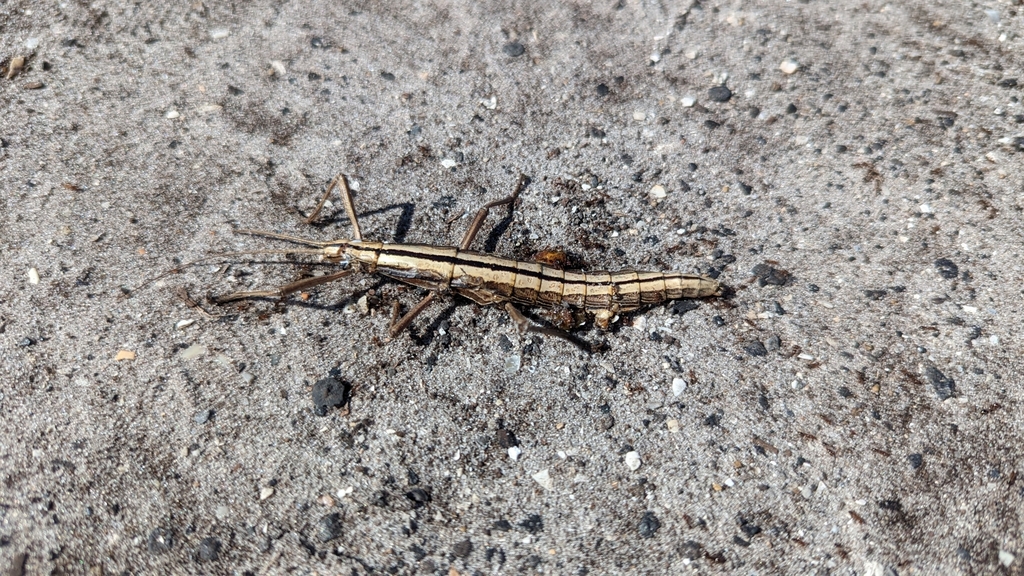
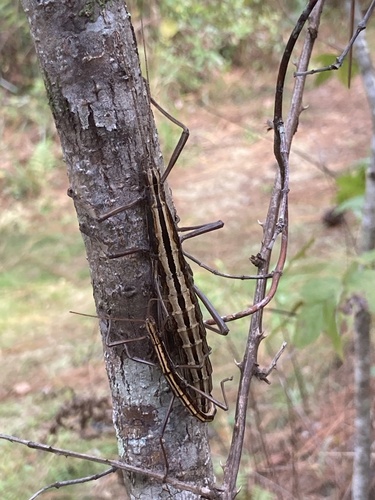
Females are about 68 mm long while males are smaller at about 42 mm. They have three black stripes and occur in brown, white, or orange color forms. Adults are most often seen in late summer and fall, usually paired with the male on the female’s back.
Source: Wikipedia
How to recognize it
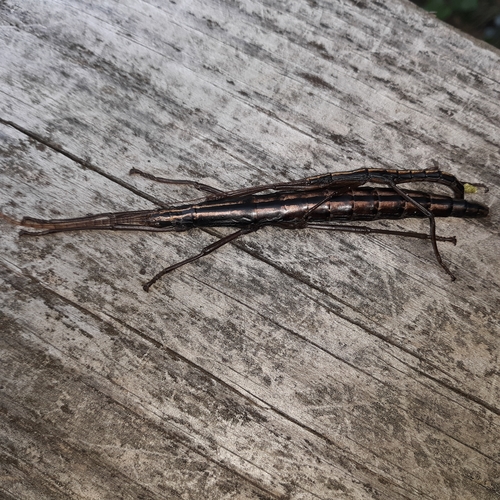
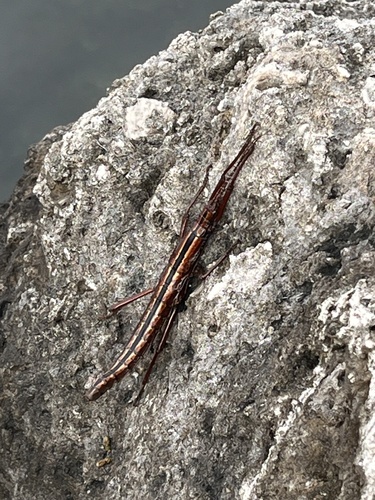
This species is a stout brown stick insect with three distinct longitudinal black stripes. It comes in three regional color forms: dark-brown with light stripes, jet-black with white stripes, or orange.
Source: Wikipedia
Does it bite or sting?
They can aim their spray at eyes and cause significant injury. The spray is mainly a cyclopentanyl monoterpene dialdehyde called anisomorphal.
Source: Wikipedia
Where it lives
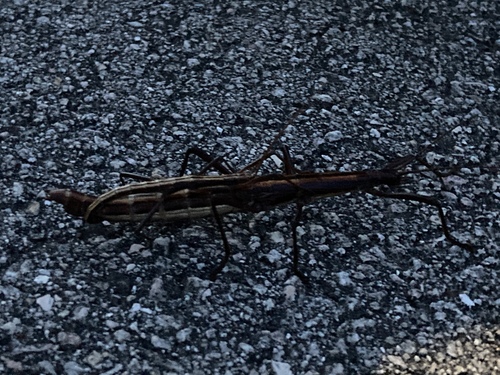
During this time they are usually found in mating pairs, the smaller male riding on the larger female’s back.
Source: Wikipedia
What it eats
Their chemical defense contains glucose, which may be part of its biosynthetic pathway.
Source: Wikipedia
Life cycle
Adults produce chemical defenses that differ by color form: white and orange forms mainly make anisomorphal, while brown forms may make anisomorphal or its stereoisomer peruphasmal.
Source: Wikipedia
When you see it
They are most commonly seen in late summer and fall.
Source: Wikipedia
Lookalikes
A close relative, Anisomorpha ferruginea, shares the potent chemical spray from glands at the front of the thorax.
Source: Wikipedia
Where it is found in the US
Recorded in 11 of 51 states and DC. Most records: Florida, Texas, Louisiana, North Carolina, Georgia, Alabama, South Carolina, Mississippi.
Darker = more records. Counts are museum and citizen-science records, not population size.
Source: GBIF
Status: native in North America; native in United States. Source: iNaturalist
Months it is reported in the US
Source: GBIF
More photos
Questions people ask
Does the Southern Two-striped Walkingstick bite or sting?
It can spray a chemical aimed at the eyes, and a direct hit can cause significant injury.
Source: Wikipedia
When am I most likely to see them?
They are most active and visible in late summer and fall, often in mating pairs.
Source: Wikipedia
Same family (Pseudophasmatidae)
Sources
- Wikipedia: https://en.wikipedia.org/wiki/Anisomorpha_buprestoides
Look it up elsewhere: GBIF · iNaturalist · BugGuide · ITIS · Wikipedia
Text written 2026-10-22 from the sources above and checked sentence by sentence against them. Data fetched 2026-10-22.