 Bug FAQ
Scaled Hump-backed Fly
Megaselia scalaris · Order: Diptera · Family: Phoridae
Also called: Common Coffin Fly, Scuttle fly
Source: Wikipedia
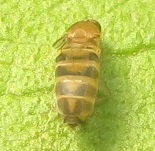
Adult hump-backed flies are about 2 mm long, yellowish with dark markings, and have a labellum with sharp teeth that can irritate skin. They thrive in warm, moist, unsanitary places such as dumpsters, trash cans, rotting food, public restrooms, homes and sewer pipes.
Source: Wikipedia
How to recognize it
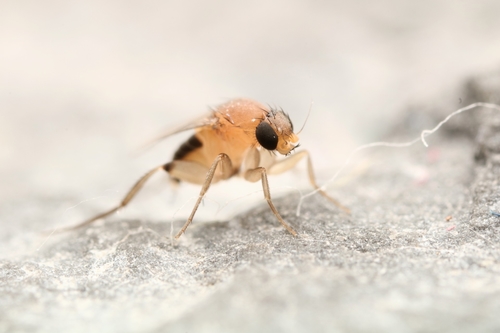
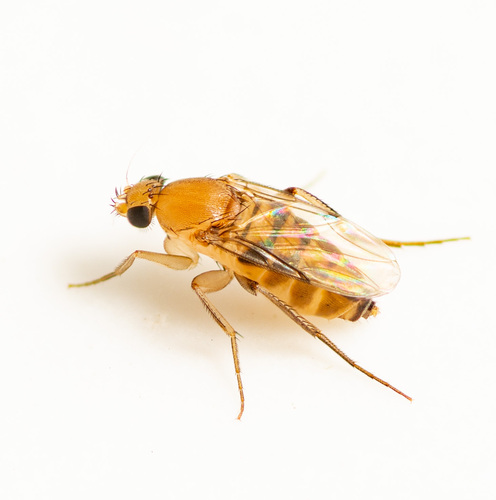
Adults are yellowish with dark markings and have a labellum and labrum covered in tiny sensory hairs, plus five pairs of sharp teeth on the labellum’s underside.
Source: Wikipedia
Size
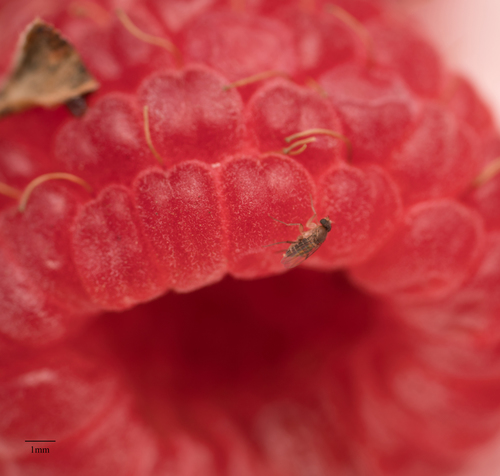
The fly measures roughly 2 mm in length.
Source: Wikipedia
Is it a pest in the house?
Larvae can be used in forensic cases to estimate time of death or neglect.
Source: Wikipedia
Does it bite or sting?
Skin inflammation in humans is likely caused by the fly’s sharp mouth-teeth, though they do not pierce the skin to feed.
Source: Wikipedia
Where it lives
They are common worldwide in warm regions and are especially found in moist, dirty environments like dumpsters, trash containers, rotting meat, vegetable waste, public washrooms, homes and sewer pipes. Their optimal breeding temperature is about 28 °C.
Source: Wikipedia
What it eats
Adults mainly feed on sugars but have also been observed eating plant material, wounds, and dead animals.
Source: Wikipedia
Life cycle
Their development is holometabolous, passing through egg, larva, pupa and adult stages. The larval stage includes three distinct instars.
Source: Wikipedia
Where it comes from
Megaselia scalaris belongs to the order Diptera, family Phoridae, and is widely distributed in warm parts of the world.
Source: Wikipedia
Lookalikes
It is one of many common Phoridae species; over 370 related species are known in North America.
Source: Wikipedia
Where it is found in the US
Recorded in 27 of 51 states and DC. Most records: California, Idaho, Texas, North Carolina, Nevada, Mississippi, New York, Ohio.
Darker = more records. Counts are museum and citizen-science records, not population size.
Source: GBIF
Months it is reported in the US
Source: GBIF
More photos

Questions people ask
Do hump-backed flies bite?
They can irritate skin with their sharp mouth-teeth, but they do not actually puncture the skin.
Source: Wikipedia
Where are these flies usually found in a house?
They like warm, moist, dirty spots such as trash cans, rotting food, bathrooms and sewer pipes.
Source: Wikipedia
What do adult hump-backed flies eat?
Adults mainly feed on sugars, though they will also consume plant material, wounds and dead animals.
Source: Wikipedia
Can they be used in forensic investigations?
Yes, their larvae can help estimate time of death or neglect in a forensic context.
Source: Wikipedia
Sources
- Wikipedia: https://en.wikipedia.org/wiki/Megaselia_scalaris
Look it up elsewhere: GBIF · iNaturalist · BugGuide · ITIS · Wikipedia
Text written 2026-10-22 from the sources above and checked sentence by sentence against them. Data fetched 2026-10-22.