 Bug FAQ
Rice Water Weevil
Lissorhoptrus oryzophilus · Order: Coleoptera · Family: Brachyceridae
Source: Wikipedia

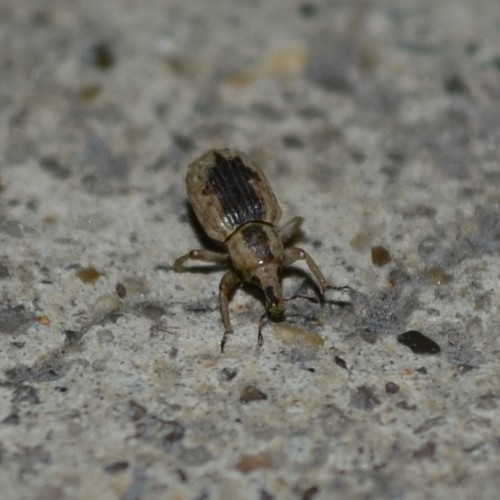
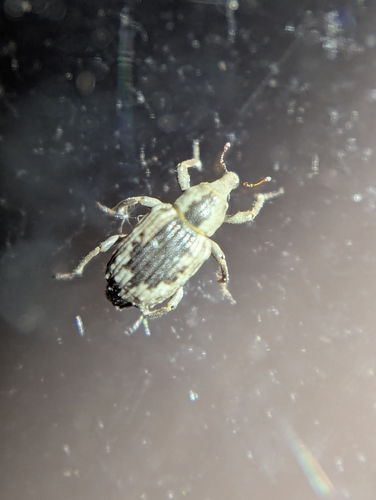
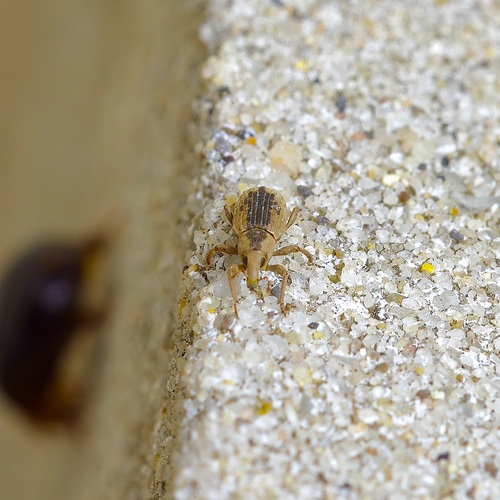
Adult rice water weevils are tiny, about 3.3-3.7 mm long, and their bodies range from dark beige to dark brown, sometimes showing a dark mark along the elytra. The larvae live underwater in the root zone of rice plants, while adults are most active in warm evenings with low wind, and they lay eggs from March to May. They are native to the southeastern United States but have spread to many Asian rice-growing regions since the 1970s and to parts of Italy since 2004.
Source: Wikipedia
How to recognize it
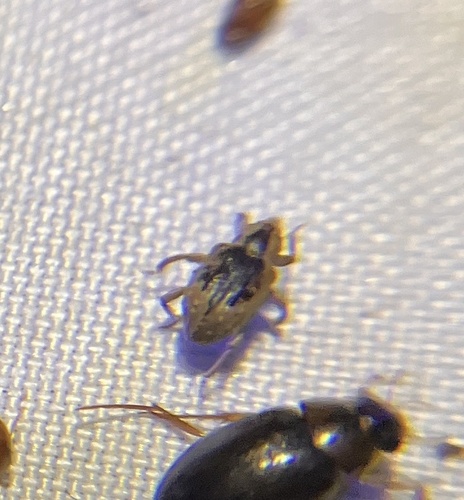
The beetle’s exoskeleton can be dark beige, brown, or dark brown, and some individuals have a dark brown to black elongated mark on the center of the elytra.
Source: Wikipedia
Size
Adults measure between 3.3 and 3.7 mm in length, including the rostrum.
Source: Wikipedia
Is it a pest in the house?
Root feeding reduces the number of tillers, the panicle-bearing parts of the rice plant.
Source: Wikipedia
How to get rid of it
- Management strategies vary by region and ecological conditions.
- Spraying insecticides is the cheapest control option for growers.
Source: Wikipedia
Where it lives
Larvae are aquatic and spend their whole life in the rhizosphere of rice plants.
Source: Wikipedia
What it eats
Adult weevils feed on rice leaves and the leaf sheath. Larvae feed on rice roots.
Source: Wikipedia
Life cycle
In Japan and California they complete one generation per year, while in southern China and the southern United States they can have three to four generations annually. Larvae pass through four instars and finish development in about 28 to 35 days.
Source: Wikipedia
When you see it
Adults begin laying eggs from March through May, depending on latitude.
Source: Wikipedia
Where it comes from
It is native to the southeastern United States. Since 1976 it has spread to rice-growing areas of China, India, Japan, Korea and Taiwan, and it has been present in Italy’s Piedmont and Lombardy regions since 2004.
Source: Wikipedia
Lookalikes
A related species, Lissorhoptrus brevirostris, occurs in Cuba, the Dominican Republic, Colombia, Suriname and Venezuela.
Source: Wikipedia
Where it is found in the US
Recorded in 15 of 51 states and DC. Most records: Louisiana, Texas, Minnesota, Florida, Kansas, Mississippi, South Carolina, Arkansas.
Darker = more records. Counts are museum and citizen-science records, not population size.
Source: GBIF
Months it is reported in the US
Source: GBIF
More photos
Questions people ask
How many generations can rice water weevil produce in a year?
In Japan and California they have one generation per year, but in southern China and the southern United States they may have three to four generations annually.
Source: Wikipedia
What is the cheapest way to control rice water weevil?
Spraying insecticides is the least expensive control method available to growers.
Source: Wikipedia
Do rice water weevil larvae damage rice plants?
Yes, the larvae feed on the roots, which reduces the number of tillers the plant can produce.
Source: Wikipedia
Same family (Brachyceridae)

Sources
- Wikipedia: https://en.wikipedia.org/wiki/Lissorhoptrus_oryzophilus
Look it up elsewhere: GBIF · iNaturalist · BugGuide · ITIS · Wikipedia
Text written 2026-10-26 from the sources above and checked sentence by sentence against them. Data fetched 2026-10-26.