 Bug FAQ
Psilothrix viridicoerulea
Psilothrix viridicoerulea · Order: Coleoptera · Family: Dasytidae
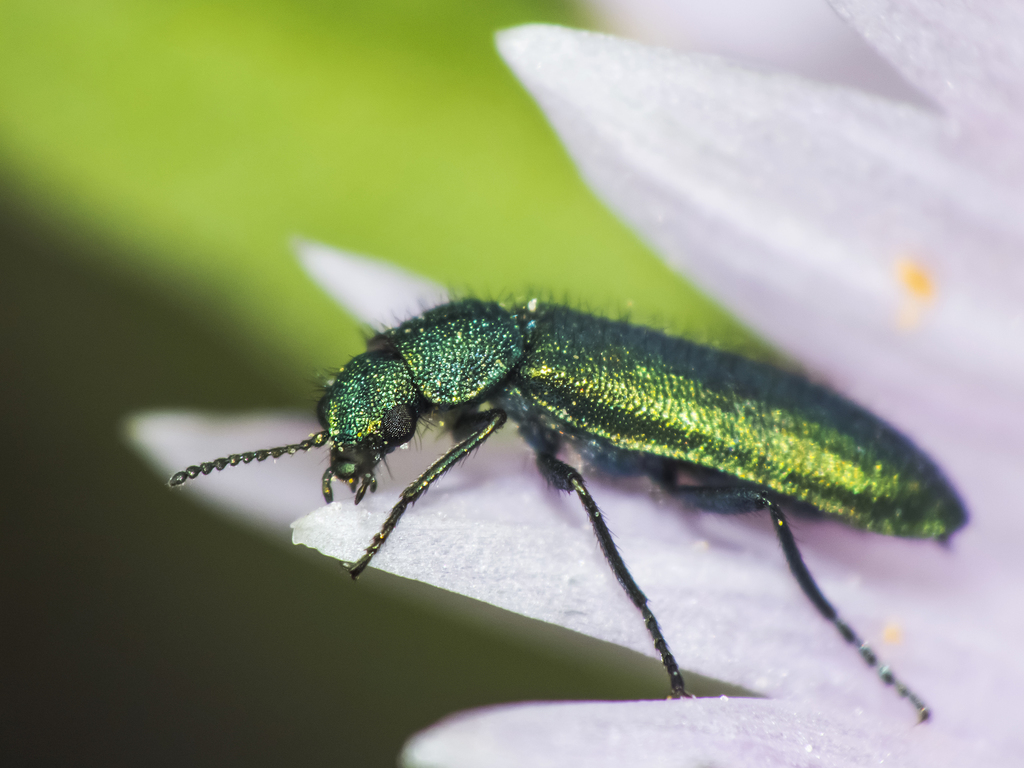
Adult beetles are 4.8 to 6.6 mm long and shine metallic bluish-green. They live on meadows and grasslands in summer, feeding on flowers and boring into stems of certain weeds.
Source: Wikipedia
How to recognize it
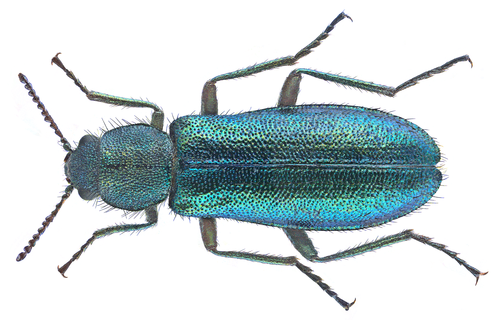
Pronotum and elytra are heavily punctured and covered with black upright hairs; elytra are very elongated and square at the base. Legs are long, slender, greenish and hairy; the male pygidium has a small V-shaped notch.
Source: Wikipedia
Size
Adults measure between 4.8 and 6.6 mm in length.
Source: Wikipedia
What it eats
Larvae start by feeding on dead insects, then become plant-eaters, boring longitudinal galleries in stems of annual weeds such as Ferula, Magydaris, Carlina, and Cirsium. The species is often linked with grasses.
Source: Wikipedia
Life cycle
Metamorphosis occurs in late winter inside the substrate, and adults emerge in spring.
Source: Wikipedia
When you see it
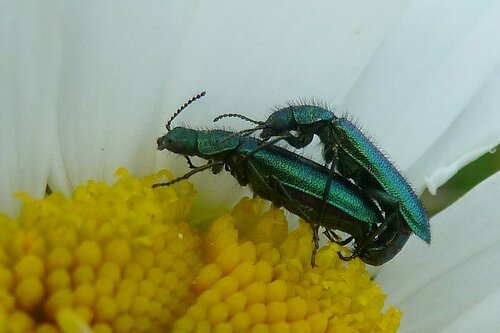
Adults are most noticeable in summer on flowering plants.
Source: Wikipedia
Where it comes from
Found throughout most of Europe and the Near East, with localized populations on England’s southern coast.
Source: Wikipedia
Lookalikes
It resembles the related species Psilothrix aureola.
Source: Wikipedia
More photos
Sources
- Wikipedia: https://en.wikipedia.org/wiki/Psilothrix_viridicoerulea
Look it up elsewhere: GBIF · iNaturalist · BugGuide · Wikipedia
Text written 2026-10-22 from the sources above and checked sentence by sentence against them. Data fetched 2026-10-22.