 Bug FAQ
Oleander seedbug
Caenocoris nerii · Order: Hemiptera · Family: Lygaeidae

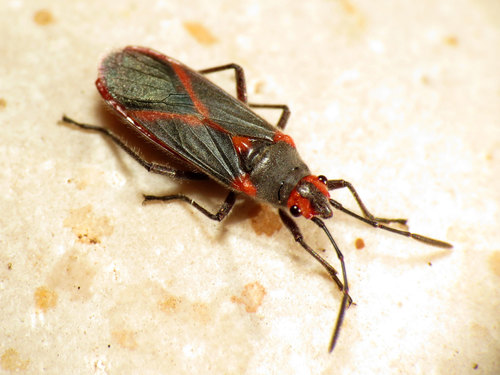
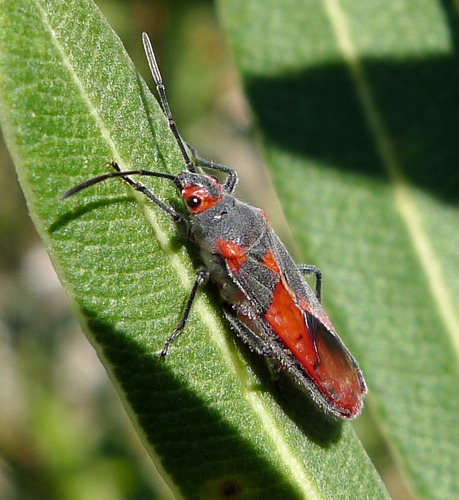
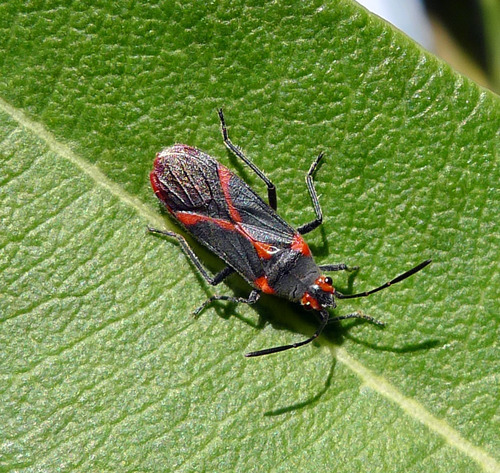
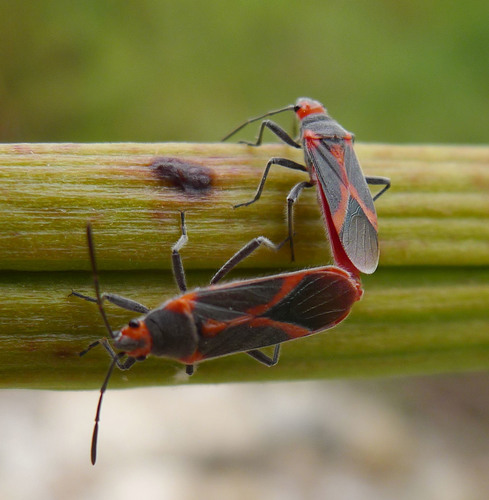
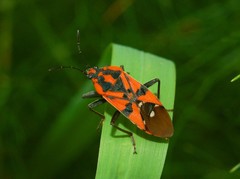
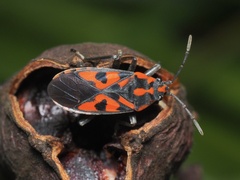
The Oleander seedbug is an elongated bug about 7.5 to 9.5 mm long, with females larger than males. Its body is black with distinct red markings: two quadrangular patches on the head, red spots on the pronotum shoulders and hemielytra edges, and a completely red scutellum and abdomen (-). It lives on Nerium oleander, where females lay eggs on the leaves, nymphs overwinter, and both nymphs and adults feed on the plant’s milky juice, fruits, and seeds (, -).
Source: Wikipedia
How to recognize it
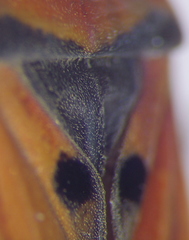
The bug’s body is elongated and mainly black with red markings. Red quadrangular patches appear on the head. Red spots are on the pronotum shoulders and inner margins of the hemielytra. The scutellum and abdomen are entirely red.
Source: Wikipedia
Size
Adults measure about 7.5 to 9.5 mm in length. Females are larger than males.
Source: Wikipedia
Where it lives
Females lay eggs on Oleander leaves, and the bugs are usually avoided by predators because they contain plant-derived toxins.
Source: Wikipedia
What it eats
Nymphs mainly suck the milky sap of Oleander, sometimes feeding on other Asclepiadaceae. Adults feed on Oleander fruits and seeds.
Source: Wikipedia
Life cycle
Nymphs overwinter before becoming adults. Females lay eggs on Oleander leaves.
Source: Wikipedia
Where it comes from
It occurs in parts of Europe, the Afrotropical realm, and the Indomalayan realm.
Source: Wikipedia
More photos
Questions people ask
What do nymphs of this bug eat?
Nymphs mainly feed on the milky juice of Oleander and may also use other Asclepiadaceae plants.
Source: Wikipedia
Same family (Lygaeidae)


Sources
- Wikipedia: https://en.wikipedia.org/wiki/Caenocoris_nerii
Look it up elsewhere: GBIF · iNaturalist · BugGuide · Wikipedia
Text written 2026-10-23 from the sources above and checked sentence by sentence against them. Data fetched 2026-10-22.