 Bug FAQ
Mouse Bot Fly
Cuterebra fontinella · Order: Diptera · Family: Oestridae
Source: Wikipedia
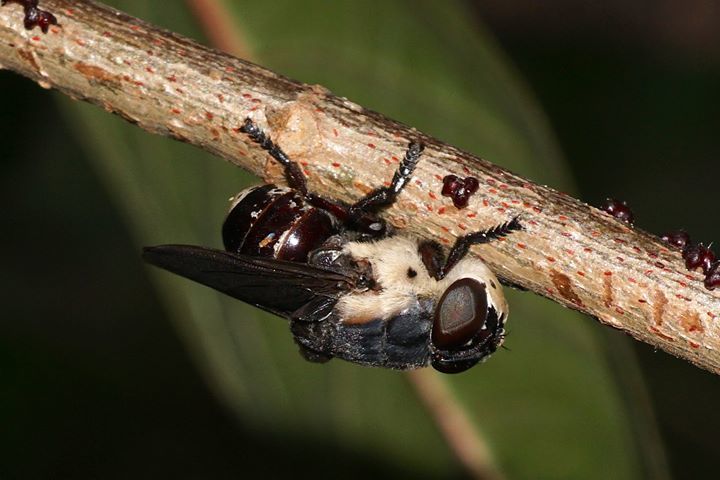
The mouse bot fly is about 1 cm long with black and yellow markings and adults can reach 30 mm, resembling bees. It lives in deciduous forests of North America, especially near running water and low-elevation vegetation. Larvae develop inside white-footed mice, changing from golden brown to black, and in rare cases can infest humans, producing a large skin bump.
Source: Wikipedia
How to recognize it
Adults have black hair on the scutum and a black spot on the anipisterum.
Source: Wikipedia
Size
The fly is about 1 cm long and shows a black and yellow pattern. Adults can grow to about 30 mm and look similar to bees.
Source: Wikipedia
Is it a pest in the house?
In rare cases it can parasitize humans, producing a large bump on the skin.
Source: Wikipedia
Can it bite, sting or make you sick?
It has been reported to parasitize humans, leading to a noticeable skin bump.
Source: Wikipedia
How to get rid of it
- The insecticide Ronnel can stop larval development by preventing larvae from boring breathing holes in the host’s skin.
- Hosts that have been previously infested may develop resistance to further infestation.
Source: Wikipedia
Where it lives
It inhabits deciduous forests across North America. It prefers territories near running water with low-elevation vegetation.
Source: Wikipedia
What it eats
The larvae feed on the white-footed mouse, using the host as their primary food source.
Source: Wikipedia
Life cycle
Eggs measure about 1.05 mm long and 0.03 mm wide. During development the larvae change color from golden brown to black.
Source: Wikipedia
When you see it
Males fly around their territories when temperatures rise above 20 °C, usually in the early afternoon. Their activity is strongly temperature-dependent, influencing how common they are throughout the year.
Source: Wikipedia
Where it comes from
It is found throughout most of the United States, southern Canada and northern Mexico.
Source: Wikipedia
Lookalikes
It looks similar to other Cuterebra species, but the host species is the easiest way to tell them apart.
Source: Wikipedia
Where it is found in the US
Recorded in 43 of 51 states and DC. Most records: Massachusetts, New York, Pennsylvania, Ohio, Maine, Washington, Minnesota, Virginia.
Darker = more records. Counts are museum and citizen-science records, not population size.
Source: GBIF
Status: native in North America; native in Canada. Source: iNaturalist
Months it is reported in the US
Source: GBIF
More photos

Questions people ask
How can I prevent infestation?
Applying the insecticide Ronnel can stop larval development.
Source: Wikipedia
What does the skin bump look like?
A large bump appears on the skin where the parasite is attached.
Source: Wikipedia
When are the flies active?
Males fly when temperatures exceed 20 °C, typically in the early afternoon.
Source: Wikipedia
How can I tell this fly apart from similar species?
Identify the host species; different Cuterebra target different hosts.
Source: Wikipedia
Sources
- Wikipedia: https://en.wikipedia.org/wiki/Cuterebra_fontinella
Look it up elsewhere: GBIF · iNaturalist · BugGuide · ITIS · Wikipedia
Text written 2026-10-25 from the sources above and checked sentence by sentence against them. Data fetched 2026-10-25.