 Bug FAQ
Mournful Thyris Moth
Pseudothyris sepulchralis · Order: Lepidoptera · Family: Thyrididae
Also called: Mournful Pseudothyris Moth, Mournful Thyris
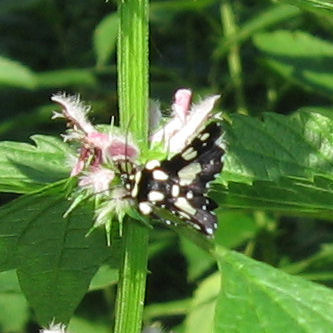
The mournful thyris moth is a small day-flying moth with a wingspan of about 15 to 23 mm and a black body marked with white spots. Its larvae are about 18 mm long, feed on Smilax leaves, roll a leaf into a pouch to pupate, and emerge as adults for a brief 2 to 3-week flight period in North America.
Source: Wikipedia
How to recognize it
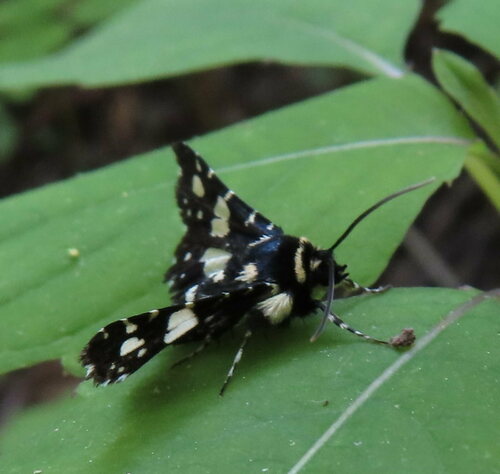
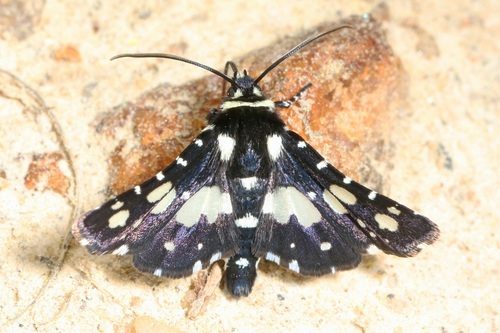
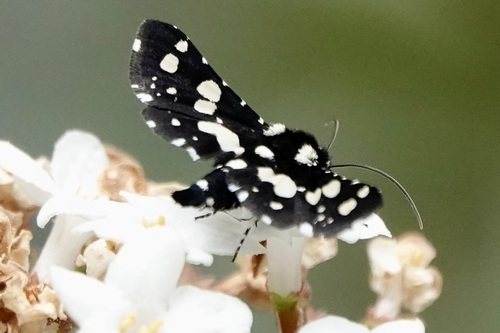
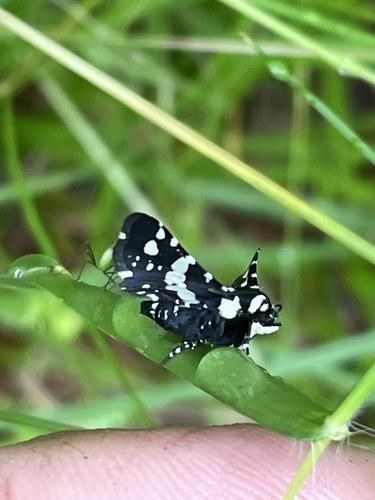
Adults have a black body with distinctive white spots and marks.
Source: Wikipedia
Size
Adult wingspan ranges from 15 to 23 mm (0.59 to 0.91 in). Larvae grow to about 18 mm (0.71 in) in length.
Source: Wikipedia
Where it lives
It is a day-flying moth found throughout North America.
Source: Wikipedia
What it eats
Larvae feed on plants of the Smilax genus. Adults are rarely seen feeding on flowers.
Source: Wikipedia
Life cycle
The larva cuts a near-perfect circle in a leaf, rolls it into a pouch-shaped cocoon, and hibernates there until the next year. Adults are on the wing for only 2 to 3 weeks.
Source: Wikipedia
When you see it
Their flight period lasts about two to three weeks each year.
Source: Wikipedia
Where it comes from
The species occurs across North America.
Source: Wikipedia
Where it is found in the US
Recorded in 36 of 51 states and DC. Most records: Texas, Tennessee, Oklahoma, North Carolina, Virginia, Georgia, Arkansas, Alabama.
Darker = more records. Counts are museum and citizen-science records, not population size.
Source: GBIF
Status: native in North America; native in United States; native in Canada. Source: iNaturalist
Months it is reported in the US
Source: GBIF
More photos
Questions people ask
What do the larvae of the mournful thyris moth eat?
The caterpillars feed on Smilax species.
Source: Wikipedia
How long are adult mournful thyris moths active?
Adults are active for only about two to three weeks during their flight period.
Source: Wikipedia
Where can I find the mournful thyris moth?
It is found throughout North America as a day-flying moth.
Source: Wikipedia
Sources
- Wikipedia: https://en.wikipedia.org/wiki/Pseudothyris_sepulchralis
Look it up elsewhere: GBIF · iNaturalist · BugGuide · Wikipedia
Text written 2026-10-23 from the sources above and checked sentence by sentence against them. Data fetched 2026-10-23.