 Bug FAQ
Mediterranean Mantis
Iris oratoria · Order: Mantodea · Family: Eremiaphilidae
Also called: Mantis
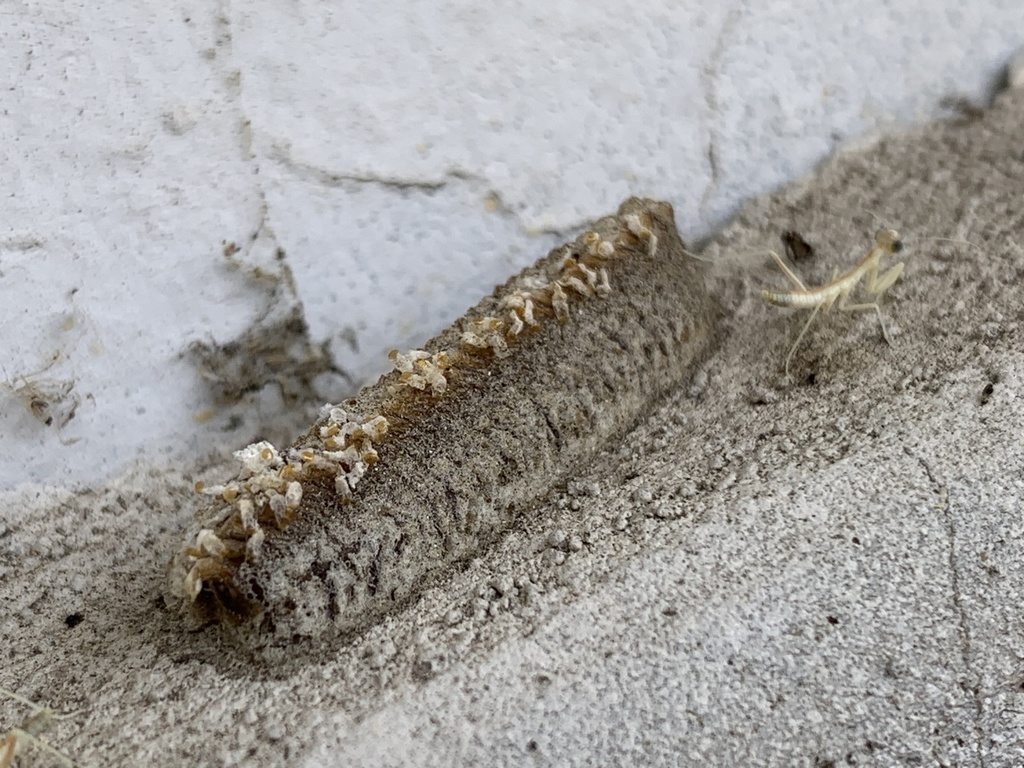
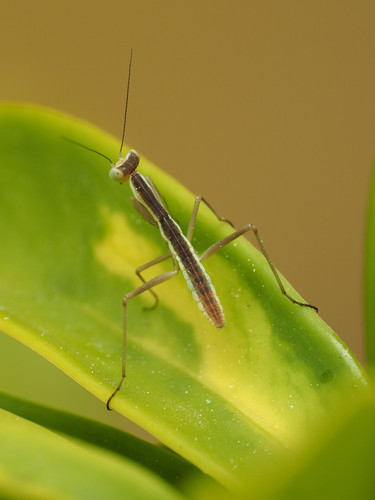
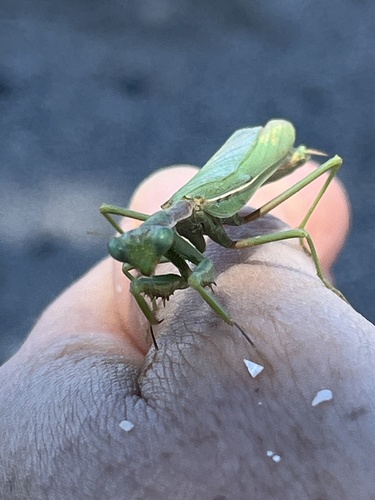
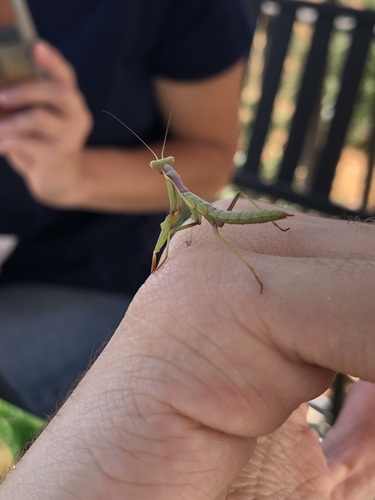
The Mediterranean mantis grows to about 6.5 cm long and changes from pale when young to grass-green as an adult. It can be told apart by a red-orange spot on the underside of its fourth abdominal segment and shorter cerci, plus violet-brown eyespots on its hind wings.
Source: Wikipedia
How to recognize it
When the wings are opened, two large violet-brown eyespots appear on the hind wings.
Source: Wikipedia
Size
Adults reach about 6.5 cm (2.6 in) in length.
Source: Wikipedia
What it eats
It eats fewer orthopteran insects and fewer long-bodied insects than the related Stagmomantis limbata.
Source: Wikipedia
Life cycle
Females can reproduce without males when males are scarce (parthenogenesis).
Source: Wikipedia
When you see it
In California, it appears later in the season than Stagmomantis limbata but remains active longer into the year.
Source: Wikipedia
Where it comes from
It is native to many Mediterranean and nearby countries, including Albania, Greece, Italy, Spain, North Africa, and parts of Asia.
Source: Wikipedia
Lookalikes
Females have wings shorter than the abdomen, similar to some Stagmomantis species, but can be distinguished by the visible hind-wing eyespots.
Source: Wikipedia
Where it is found in the US
Recorded in 8 of 51 states and DC. Most records: California, Arizona, Nevada, Texas, New Mexico, Utah, Hawaii, Illinois.
Darker = more records. Counts are museum and citizen-science records, not population size.
Source: GBIF
Status: introduced in North America; introduced in United States. Source: iNaturalist
Months it is reported in the US
Source: GBIF
More photos
Questions people ask
Can I identify this mantis easily?
Yes, look for the red-orange spot on the fourth abdominal segment and the violet-brown eyespots on the hind wings.
Source: Wikipedia
Same family (Eremiaphilidae)

Sources
- Wikipedia: https://en.wikipedia.org/wiki/Iris_oratoria
Look it up elsewhere: GBIF · iNaturalist · BugGuide · ITIS · Wikipedia
Text written 2026-10-22 from the sources above and checked sentence by sentence against them. Data fetched 2026-10-22.